
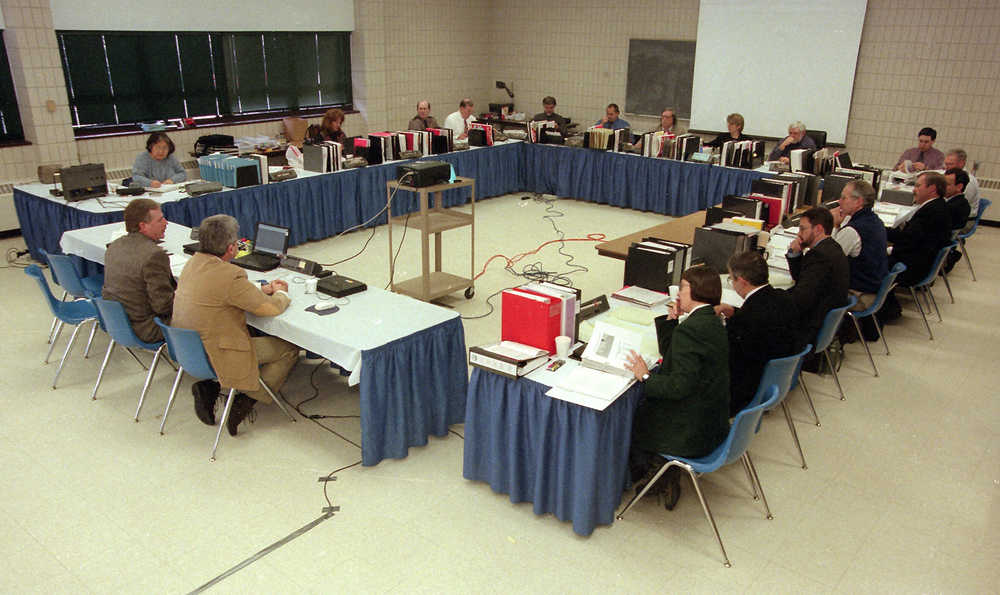
Despite several hours of discussion, the Alaska’s Board of Fisheries members did not come to a decision whether to move its 2017 Upper Cook Inlet meeting to the Kenai Peninsula.
The board has not met on the peninsula since 1999. Multiple entities from the peninsula, including the cities of Kenai, Soldotna, Seldovia and Homer sent letters to the board requesting that it host its next meeting on the peninsula to allow the residents a chance to participate.
The meeting was originally planned to take place in Anchorage, but the Boards Support staff did not find a venue for the originally scheduled meeting dates. During the discussion about moving the meeting dates to Feb. 22 – March 9, 2017, the question arose of whether the board should consider relocating the meeting to the Kenai Peninsula.
“I’m reluctant to support the motion because it does seem to by default accept Anchorage as the location,” said board member Fritz Johnson from Dillingham. “I think in fairness it’s time for a meeting on the Kenai Peninsula.”
Johnson argued that it has already been a long time since the meeting was held on the peninsula and there may be little chance to do so in the future. Moving the dates seemed like a de facto acknowledgement that the meeting would be held in Anchorage, based on agreements with a venue, he said.
Chairman Tom Kluberton, of Talkeetna, said changing the dates would leave the option open to hold the meeting in Anchorage but a venue change could be discussed. He also mentioned the option of splitting the meeting between Kenai and Anchorage, where the proposals would be heard on the peninsula and the deliberation would take place in Anchorage. However, he said, the technicalities would make splitting the meeting difficult.
“I’ve had that discussion with the commissioner and haven’t found a way in my mind to make that work,” Kluberton said. “Once we come to deliberating, how one would split an agenda so intricately interwoven as the mixed-stock fishery of Cook Inlet — I could never make up my mind on how to split that.”
Board member Reed Morisky from Fairbanks said the meeting was already locked into Anchorage, saying the board voted a year ago on the location and that it should be held in a central spot.
Wasilla has not hosted a meeting in many years either, he said.
“I understand there’s a lot of raw emotions on this, different areas of the state having different opinions, but the board has already voted on this a year ago in Juneau,” Morisky said. “Anchorage is a neutral location. I think everybody agrees on that.”
Morisky suggested the idea of having three back-to-back meetings, one each in Wasilla, Anchorage and in Kenai. The Upper Cook Inlet issues may require more frequent meetings than other fishing subdistricts, he said.
“This is not against the folks on the Kenai,” Morisky said. “What it’s about is including all the users of the resources in a neutral location. I think there’s some room to look at this down the road but keep the commitment for a neutral location, which is Anchorage.”
Member Sue Jeffrey from Kodiak recommended setting the meeting on the peninsula and holding at least part of the meeting in Anchorage to meet the other areas of Upper Cook Inlet halfway. The board usually sends delegations of representatives to the affected communities before the meeting who then return to the main meeting, having heard the community’s concerns. Jeffrey said it would be better for the board to hear the community’s concerns in person.
“Thinking about it and thinking about the fact that a lot of people who are affected by the fisheries in Kenai would really be disenfranchised when we don’t meet there once every ten years, there are people who cannot afford to attend,” Jeffrey said. “I think that it would be beneficial for us as a board for all of us to be there to consider the ramifications of the decisions that we make on the Kenai Peninsula and all the residents there.”
Kluberton replied that a work session is set for Kenai next year with time for public testimony and suggested political interests could be driving the desire to meet on the peninsula.
“Political pressure is putting us in a position to reconsider (the meeting location),” Kluberton said. “This is supposed to be an organization that operates independently of fisheries issues.”
The board voted to change the dates to the later time, leaving open the option to move the meeting location in the future. Johnson added a motion to continue the discussion of the venue change in the future, which passed 4-3. The board will take up the topic again at the Bristol Bay Finfish meeting, set to take place Dec. 2–9 at the Egan Civic & Convention Center in Anchorage. Public comments will be accepted until Nov. 19.
Reach Elizabeth Earl at elizabeth.earl@peninsulaclarion.com.
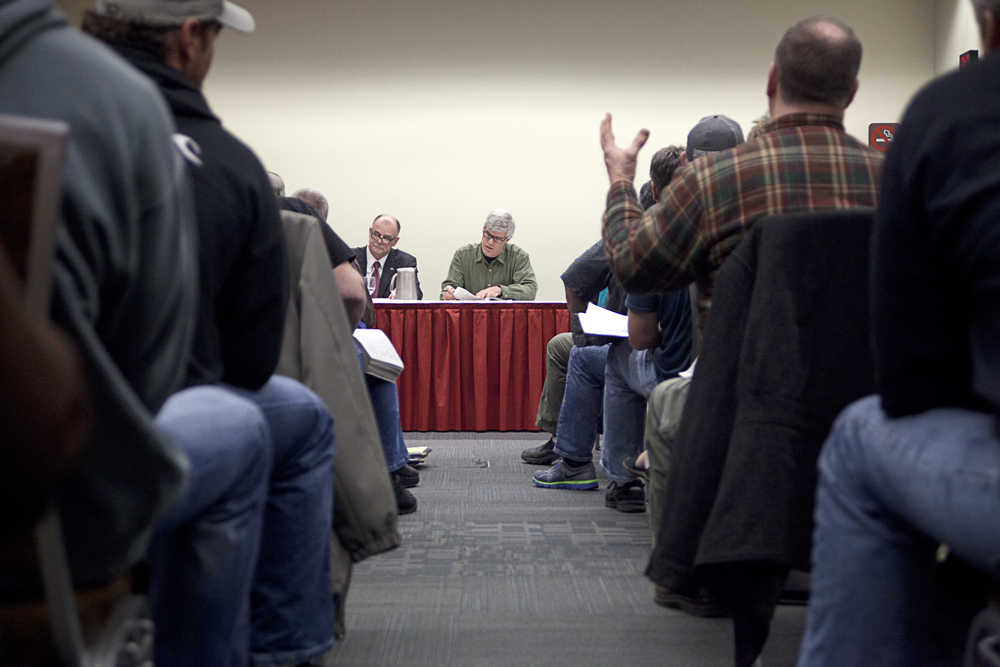
Photo by Rashah McChesney/Peninsula Clarion In this Feb. 6, 2014 file photo Alaska Board of Fisheries members John Jensen and Tom Kluberton hear committee testimony during the triennial Upper Cook Inlet meeting Thursday Feb. 6, 2014 in Anchorage, Alaska. Kluberton, now the board’s chairperson, drove the board’s decision to put off voting on allowing a meeting on Cook Inlet’s issues to take place on the Kenai Peninsula during an Oct. 22, 2015 meeting in Anchorage. The board will again take up the issue during it’s Bristol Bay meeting in December.
