
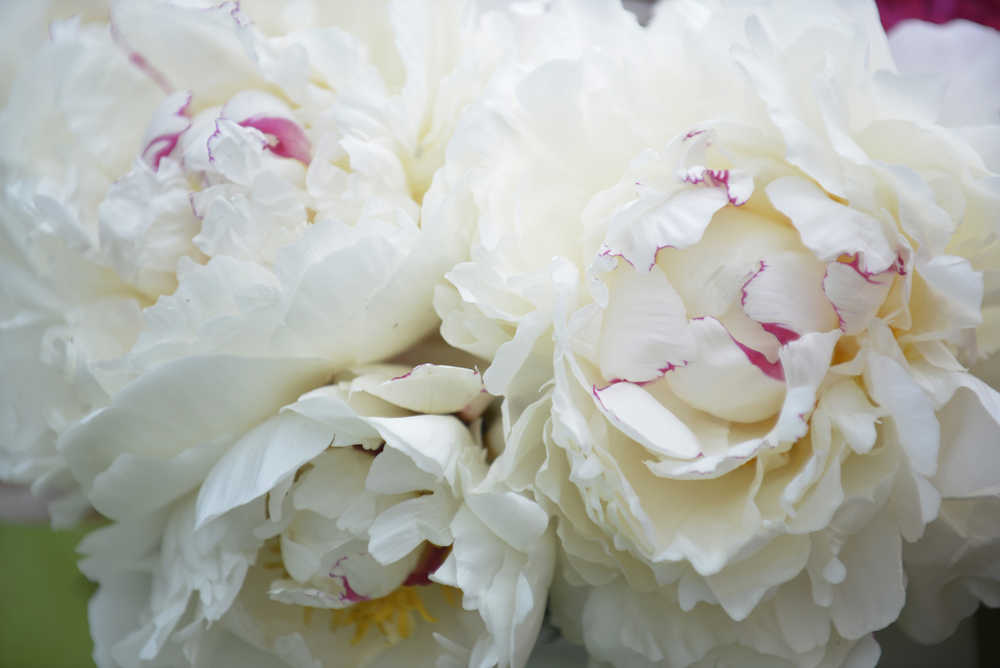
Marketing is on the minds of many peony producers as they prepare for the approaching season.
Fittingly, it is the leading topic at the Alaska Peony Growers Association’s 2016 Alaska Peony Conference on Jan. 28-30 at the Land’s End Resort in Homer.
“First of all, there has never been any peonies available in the world in the time period we have them,” said Rita Jo Schoultz, co-organizer of the event and owner of the state’s oldest and largest peony farm. “It is educating that they are available.”
Schoultz now manages 15,000 plants — some 10 years old — on her family farm, Alaska Perfect Peony, in Homer. She said she and her husband have no plans to get any bigger, and expect to be surpassed in production at some point, which she said she isn’t too worried about.
Buds are usually ideal for harvesting in mid-July through mid-August and, as Shoultz mentioned, Alaska is the only region that has crops to supply to domestic or international demand in the summer months. She said by far the biggest potential market is in the Lower 48.
Most brides Outside, however, have little knowledge of what is being grown up here, Shoultz said. Alaska-grown peonies are some of the more superior yields produced at any point annually, she said.
They stay in the stems longer because of the colder soil temperatures so the blooms get bigger, coupled with the longer daylight hours that foster more saturated coloring in the petals, Shoultz said.
There are about 75 member farms in the growers association, she said.
Right now the the industry is made up of a mix of well-established farms, such as Shoultz’s own, a large group of new growers whose plants are not mature enough to clip buds from.
A majority of producers, nearly half, are just starting to look for outlets to sell off their stockpiles, she said.
Peony bushes must be in the ground for 3-5 years before blooms can be picked, otherwise it may damage the still-developing plant. Shoultz first seeded her soils in 2006 and wasn’t picking peonies until 2009.
Wayne Floyd, who runs Cool Cache Farms, LLC, which operates out of Nikiski, has also had a hand in putting together this weekend’s conference. He said the annual gathering has been held in Homer for nearly eight years, and usually a group of a dozen association members agree to help out.
“It is a good outlet of information for the peony grower regardless of what level they are at,” Floyd said.
On the subject of marketing, speakers have been called in to cover the areas of advertising, website design, determining trends and developing a market, Floyd said. And then there are the usual topics such as soil nutrition, pack houses, shipping, mitigating risks, figuring out which varieties work best where and fighting disease, he said.
It is important for even established growers to still have these discussions because there are mistakes such as problems with drainage, over-mulching, or mulching at the wrong time that can still kill swathes of mature root systems, Shoultz said.
Bound for some mouths is likely the discussion on how to fend off the potentially disastrous results of the most recent winters’ fluctuating weather.
Floyd said freeze-thaw cycles common this year and in 2014-2015 completely wiped out a few farms. He lost 400 of his 3,000 plants from the lack of snow that protects roots dramatic weather patterns.
No one knows exactly how to combat it right now, Floyd said.
He said this year’s peony conference is poised to be one of the best so far.
Don Hollingsworth, who manages 17,000 plants on Hollingsworth Peonies farm, based in Montana, is the keynote speaker, and scheduled to talk Friday.
“He is a wealth of information and a very humble man,” Floyd said. “When he is talking the room goes quiet. I really admire the gentleman.”
There will also be classes and roundtable discussions and breakout sessions to supplement, Shoultz said.
Floyd said those who choose to pass are missing out.
“If they are peony growers and they didn’t go, they probably missed one of the best conferences because of our speakers,” he said.
Reach Kelly Sullivan at kelly.sullivan@peninsulaclarion.com.
