
“Mayday! The engine has failed! This is an emergency! Prepare for ditching!” These dreaded words hopefully no one hears. However, in the event of an emergency, having muscle memory on what actions are needed could very well be the difference between life and death.
As an itinerant wildlife biologist working this summer at the Kenai National Wildlife Refuge, I am required to take aviation safety training before stepping into a float plane to conduct aerial surveys or simply to be ferried to a remote part of the Refuge. And so here I was at the Nikiski Community Pool to learn what to do if your flight plan goes belly up in the water.
Rick Gividen and Dave Kreutzer, both trainers from Integrity Aviation Training, held a course this past Tuesday that included both a classroom component as well as a hands-on training session in the pool (aka “dunker” training). They introduced three categories of actions that help ensure survival in case of an emergency: pre-takeoff actions, egress (exiting), and post-egress survival.
“When the time to act comes, the time for preparation has passed,” stated Rick.
There are a few pre-takeoff actions that anyone flying, be it in a single engine up to a commercial airbus, could benefit from by simply taking a few moments to evaluate your environment. Rick advised to be aware of the location of the emergency exit. In smaller aircraft, you could even ask the pilot to practice opening the door. Rick spoke of a crash that ended in the worst possible way because the passenger was unable to exit the aircraft — he had never previously opened the door! Rick emphasized that the first time you open the door to the aircraft should not be in dire straits.
The same was true with simply unbuckling the safety belts. A quick practice run could really make a difference if something goes awry. Rick also stated that “all cargo can become a projectile or impediment if not properly secured.” Prior to takeoff make sure that everything is stowed away and take note of anyone or anything that is by the emergency exit. Thinking about details, such as the physical capabilities of the person responsible for opening the emergency exits to where the personal flotation device is located, could make a world of difference.
In the case of an emergency, Rick laid out 7 steps for a successful egression. For those of you who have completed the course, a quick refresher won’t hurt:
1) State “I’m a survivor” and set yourself in the right mindset to succeed.
2) Unplug flight helmet.
3) Open the door to the aircraft and brace for impact.
4) Slow count to 4 and sit up.
5) Locate, clear exit and grab a reference point.
6) Release seat belt and exit the aircraft.
7) Swim hand up, head up, investigate the surface and inflate your PFD.
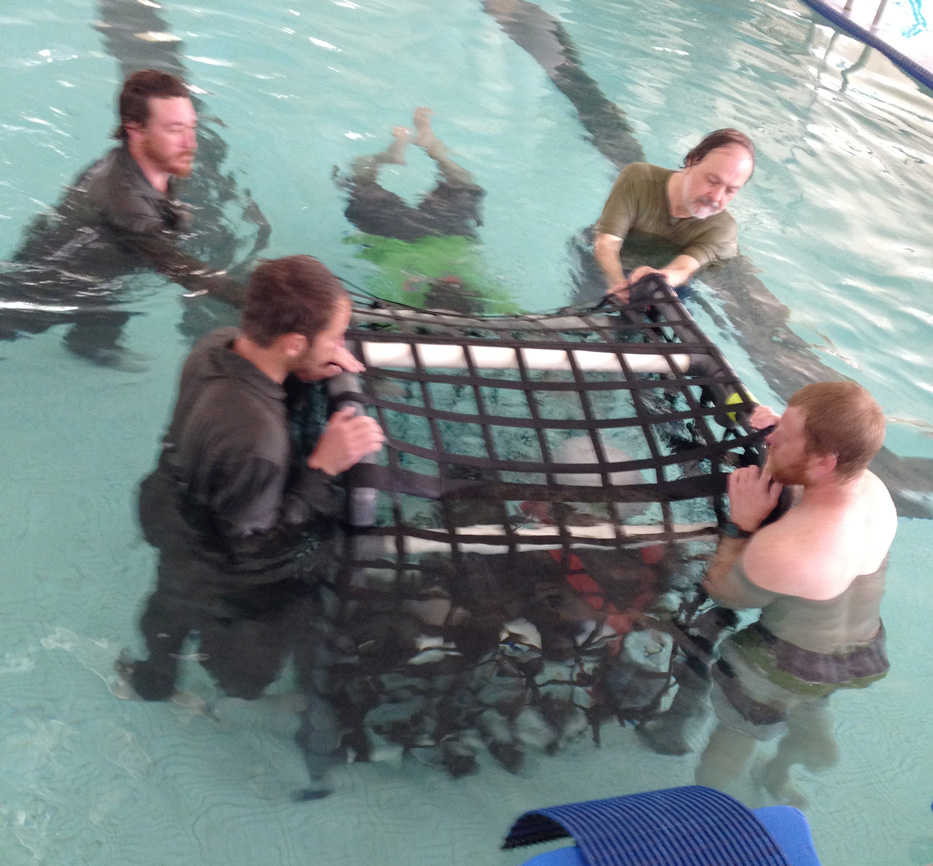
The instructors emphasized that a positive mental attitude was a huge element of success. Practicing these 7 steps took me and other students to the Nikiski pool, where we were placed in the “Home Depot 2000,” a cage made of PVC pipes, straps, a harness and a helmet plug to simulate exiting an upside down aircraft underwater.
Post-egress survival is mainly dependent on not succumbing to hypothermia or fatigue. “It’s a tragedy to successfully egress … only to succumb to hypothermia,” stated Rick. Dave reiterated this point that hypothermia is the biggest post-egression hazard.
To demonstrate survival techniques, my class practiced different floating and swimming formations in the pool. These formations were meant to utilize the warmest area of the water column, roughly the top foot of water just below the surface, as well as water that is warmed by our body heat. We got to really know each other after intertwining our limbs in formations such as “the carpet.” However, the best course of action — if the crew can make it to shore — is to start swimming. Keep an eye on every member of the crew, especially the slowest.
Survival tools and how to use them are also of extreme importance once the crew has successfully egressed. Some tools are intended for one-time use, such as dyes and flares, and should be conserved until the right moment when being spotted is most likely.
Basic preparations and survival techniques can make a huge difference for the crews that are flying into remote areas of the Refuge and other areas of the peninsula. Awareness and a refresher on training will not only give passengers on smaller aircraft peace of mind, but also the pilots who fly the helicopters and float planes that their passengers are prepared for an emergency.
Jennifer Peura is a new biological intern at the Kenai National Wildlife Refuge. You can find more information about the Refuge at http://kenai.fws.gov or http://www.facebook.com/kenainationalwildliferefuge.
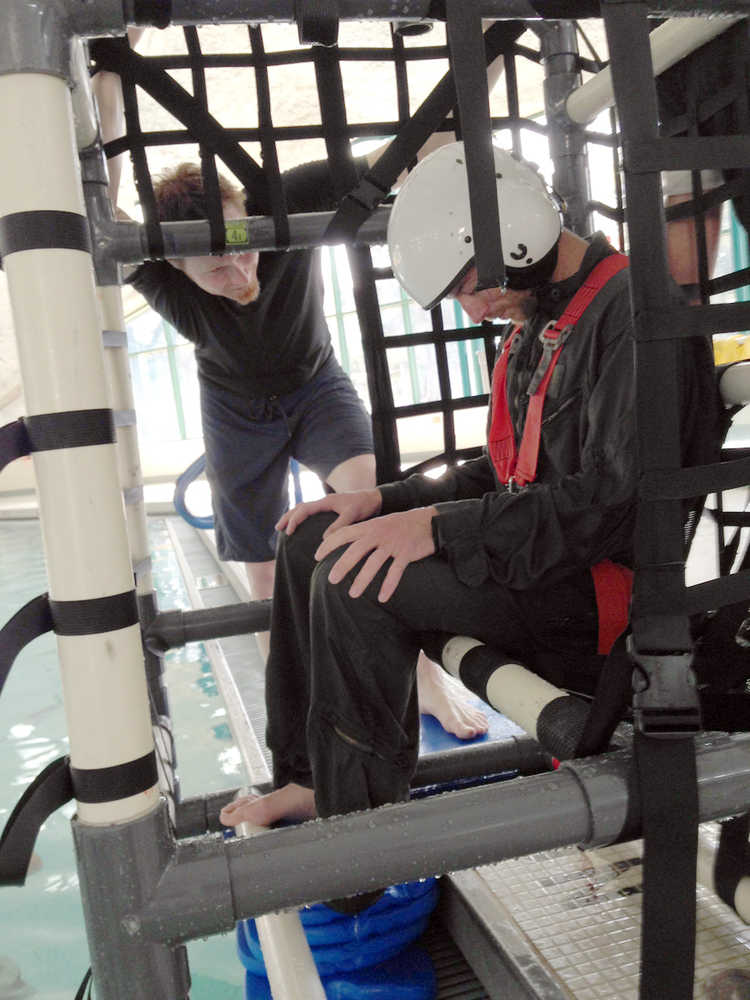
Photo courtesy Kenai National Wildlife Refuge Taylor Gregory, a U.S. Fish & Wildlife Service technician, prepares to be dunked in the “Home Depot 2000” at the Nikiski Pool.
