
Elodea, the first nonnative submersed freshwater plant to invade Alaska, was discovered on the Kenai Peninsula in late 2012. We now know that a hybrid Elodea species, common in the aquarium trade, infests Beck, Daniels and Stormy Lakes north of Nikiski.
The bad news is that Elodea really does have the potential to affect our quality of life. Elodea can grow so prolifically that it can severely degrade fish habitat, reduce dissolved oxygen, hinder boat traffic, and depress property values. And it can be spread easily, transported by float planes and motor boats to new waterbodies, where it reproduces vegetatively.
The good news is that Kenai Peninsula Cooperative Weed Management Area partners have made significant headway toward eradicating Elodea from the peninsula. Fluridone was the primary herbicide used, a chemical that essentially starves the plant by interfering with photosynthesis. The trick is to keep concentrations low enough (less than 10 parts per billion) so that it isn’t lethal to other more fluridone-tolerant native plants, while ensuring that it is in the water column long enough (45-90 days) to be taken up by Elodea during photosynthesis — in other words, Elodea has to be actively growing for it to kill both roots and leaves.
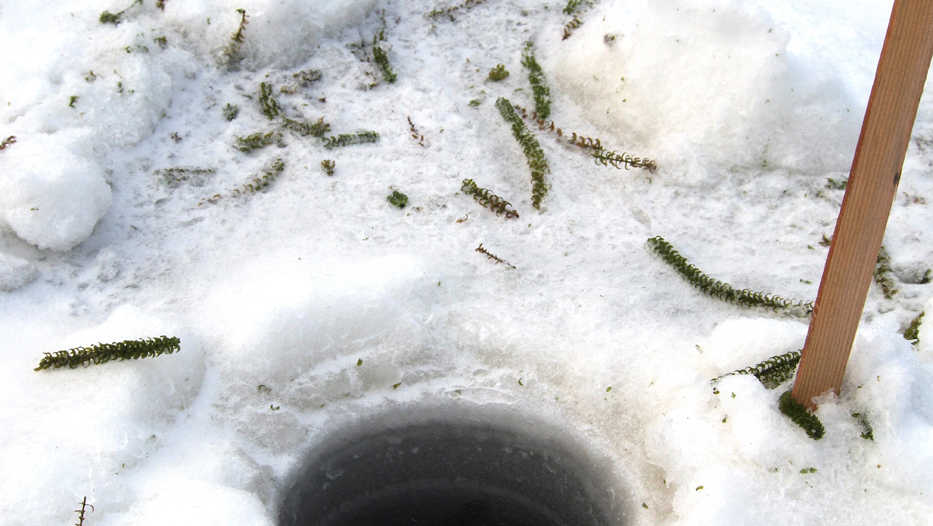
The problem is that Alaska has a short growing season and cool waters. However, unlike most native submersed aquatic plants in our local lakes, the perennial Elodea does not completely senesce. When Elodea was first surveyed in February 2013, we were stunned to see bright green strands of elodea spew out onto 2-foot-thick ice when the gasoline-powered auger was pulled out. It seems that Elodea, at least the floating strands, can photosynthesize under low light conditions during the winter.
We bet on this unusual life history trait, prescribing four treatments of fluridone over three years. We applied the first two treatments this past summer, using a pelleted formulation in mid-September with the expectation that fluridone would persist through the winter when Elodea was growing slowly. The disadvantage of relatively low uptake by plants during winter is offset by seasonally low water volume, minimal mixing (no wind due to ice cover), and reduced concerns about potential impacts to anadromous fish and human health.
There is precedent to our own efforts. A 2006 article published in the Journal of Aquatic Plant Management described how watermilfoil, another aquatic invasive species, was controlled in a Michigan lake with fluridone, first applied in October and subsequently boosted in November, with herbicide residuals maintained through the winter.
Did our bet pay off? It certainly seems so. We re-surveyed 50 sites in each of the three lakes (150 sites total) last week that had been measured previously in mid-September 2014. At that time, just before ice-in, Elodea occurred on 12 percent and 46 percent of sites in Beck and Stormy Lakes, respectively. This spring, after ice-out, Elodea occurred on ZERO and 20 percent of sites on these two lakes — real evidence that Elodea continued to die under the ice. Our measurements of fluidone concentrations in September, February and this May showed that the herbicide persisted through the winter, although declining with time.
In the case of Daniels Lake, treatment with fluridone and diquat (a second herbicide) had already knocked Elodea down to ZERO by last September (down from 22 percent of sites in May 2014), a measurement that remained ZERO when we resurveyed in May 2015. All evidence suggests our approach to eradicating Elodea from the Kenai Peninsula will be successful.
To get more information about this project, preliminary results and our plans for summer 2015, we are hosting a public meeting at the Nikiski Community Recreation Center on June 11 from 6-7:30 p.m. We encourage you to attend to get your questions answered and concerns addressed.
Dr. John Morton is the supervisory biologist at Kenai National Wildlife Refuge. Find more information at http://www.fws.gov/refuge/kenai/ or http://www.facebook.com/kenainationalwildliferefuge.
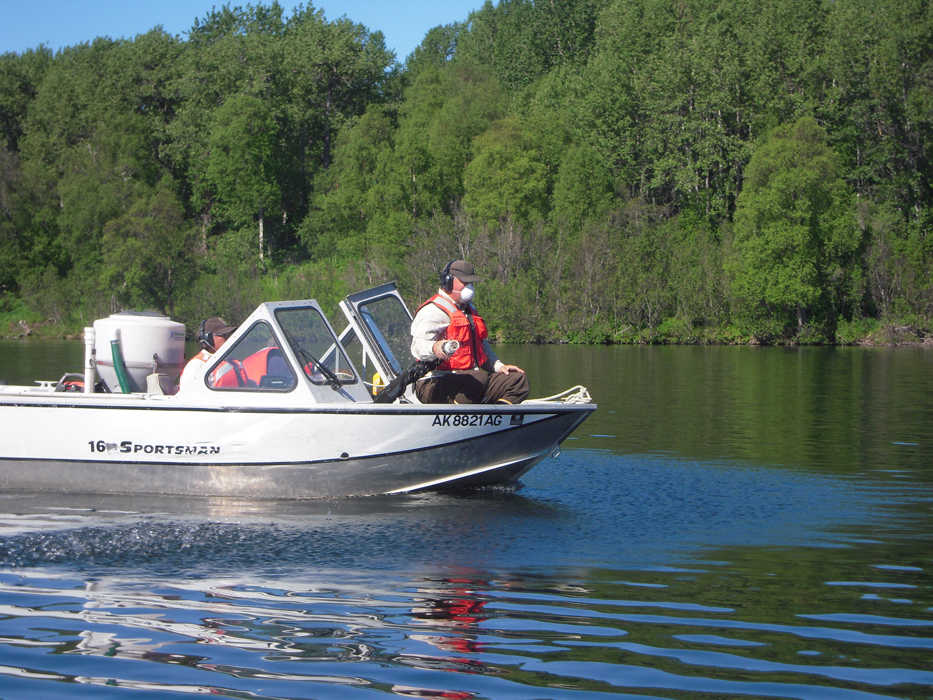
Kenai National Wildlife Refuge staff apply pelleted fluridone to kill Elodea in Beck Lake last summer. Elodea was present at 35 of 50 sampled sites in May 2014 – these same sites now have none. (Photo courtesy Kenai National Wildlife Refuge)
