Refuge Notebook: Climate change does not bode well for snowshoe hares
Published 3:14 am Friday, February 12, 2016
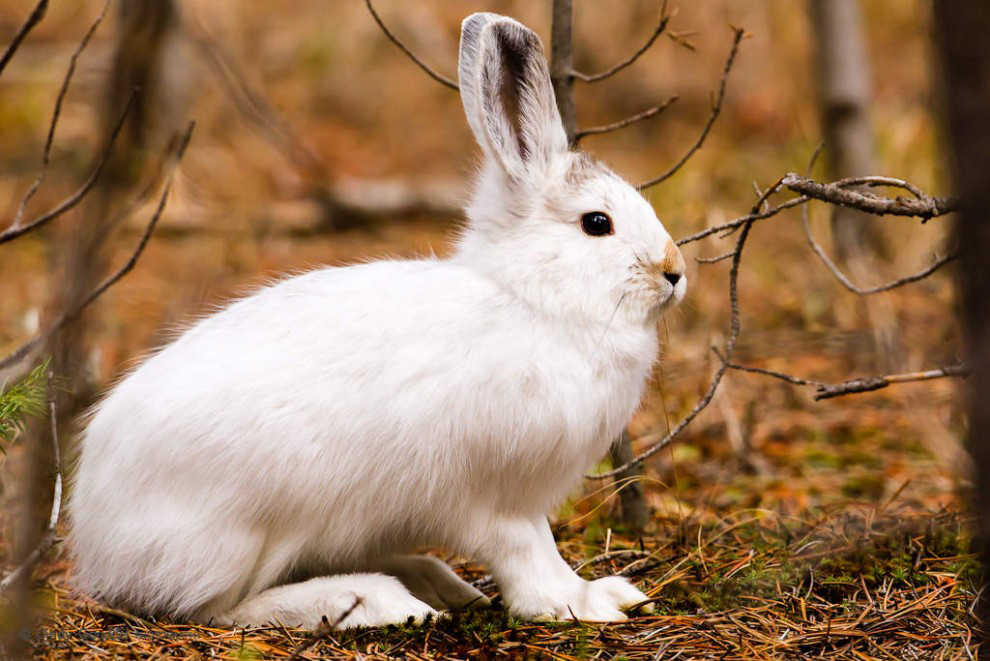
Ever wonder what happens to snowshoe hares when they seasonally molt from their brown to their white winter coat well before the winter snow arrives or does not arrive at all and melts early? White blobs on a brown or green landscape. I wondered about this mismatch but researchers from the University of Montana and North Carolina State University not only pondered this question but began detailed observations of snowshoe hares in the Rocky Mountains of western Montana in 2010 to find out.
In one part of their studies they visually checked 148 radio-collared hares once a week to determine the coat color of hares and match it with the hare’s surroundings. They discovered that the initiation of color change in the fall was fixed for hares and the rate of color change from brown to completely white took about 40 days.
However, the rate of color change from white back to brown in the spring was more plastic with the time of molt completion varying up to 19 days dependent on the duration of snow cover and individual hares. They also modeled the then current (2010-2012) snowpack duration at their study sites relative to the recent past and predicted winter snowpack would decrease by 29-35 days by mid-century and 40-60 days by the end of the century. This shorter duration was largely the result of reduced spring snow cover.
Initiation of color molts among hares was triggered by daylight length (photoperiod) not temperature, a fact already well known that can also cause seasonal changes among other species of animals. They concluded that without an evolved shift in the initiation of seasonal molt, color mismatch of white snowshoe hares on brown snowless backgrounds will increase as much as four-fold by mid-century and eight-fold by late century. Although they wondered how this shorter duration of snow cover affected the hares, they found no evidence that hares perceived their own color mismatch nor took action to shift their hiding places or changed their flight behavior responses to compensate for their conspicuousness.
Predation typically accounts for 85-100 percent of mortality in snowshoe hares. Not surprisingly, color-mismatched hares die at higher rates than color-matched hares. By observing a total of 186 radio-tagged hares in two study areas each week from 2009 to 2012, these researchers discovered that hares whose coat color mismatched their backgrounds experienced up to 7 percent decreased weekly survival rates compared to color-matched individuals. They concluded that “in the absence of adaptive response, we show that these mortality costs would result in strong population-level declines [of snowshoe hares] by the end of the century. However, natural selection acting on wide individual variation in molt phenology might enable evolutionary adaptation to camouflage mismatch. We conclude that evolutionary rescue will be critical for hares and other color molting species to keep up with climate change.”
Locally, future snowpack projections by the Alaska Climate Science Center which included the Kenai Peninsula showed (1) that from October to March and between sea level and about 1,600 feet, the number of precipitation days that fall as snow will decrease by 23 percent from historical levels; (2) the snow water equivalent will decline most in the autumn (October and November) and at elevations lower than about 5,000 feet; and (3) that the percent of the landscape dominated by snow will decrease.
Based on the Montana snowshoe hare studies and the declining amount and duration of projected snow cover in our region, snowshoe hare populations on the Kenai Peninsula face an uncertain future in the coming decades.
Dr. Ted Bailey is a retired Kenai National Wildlife Refuge wildlife biologist. He maintains a keen interest in the Kenai Peninsula’s wildlife and natural history. Find more information about the Refuge at http://kenai.fws.gov or http://www.facebook.com/kenainationalwildliferefuge.