
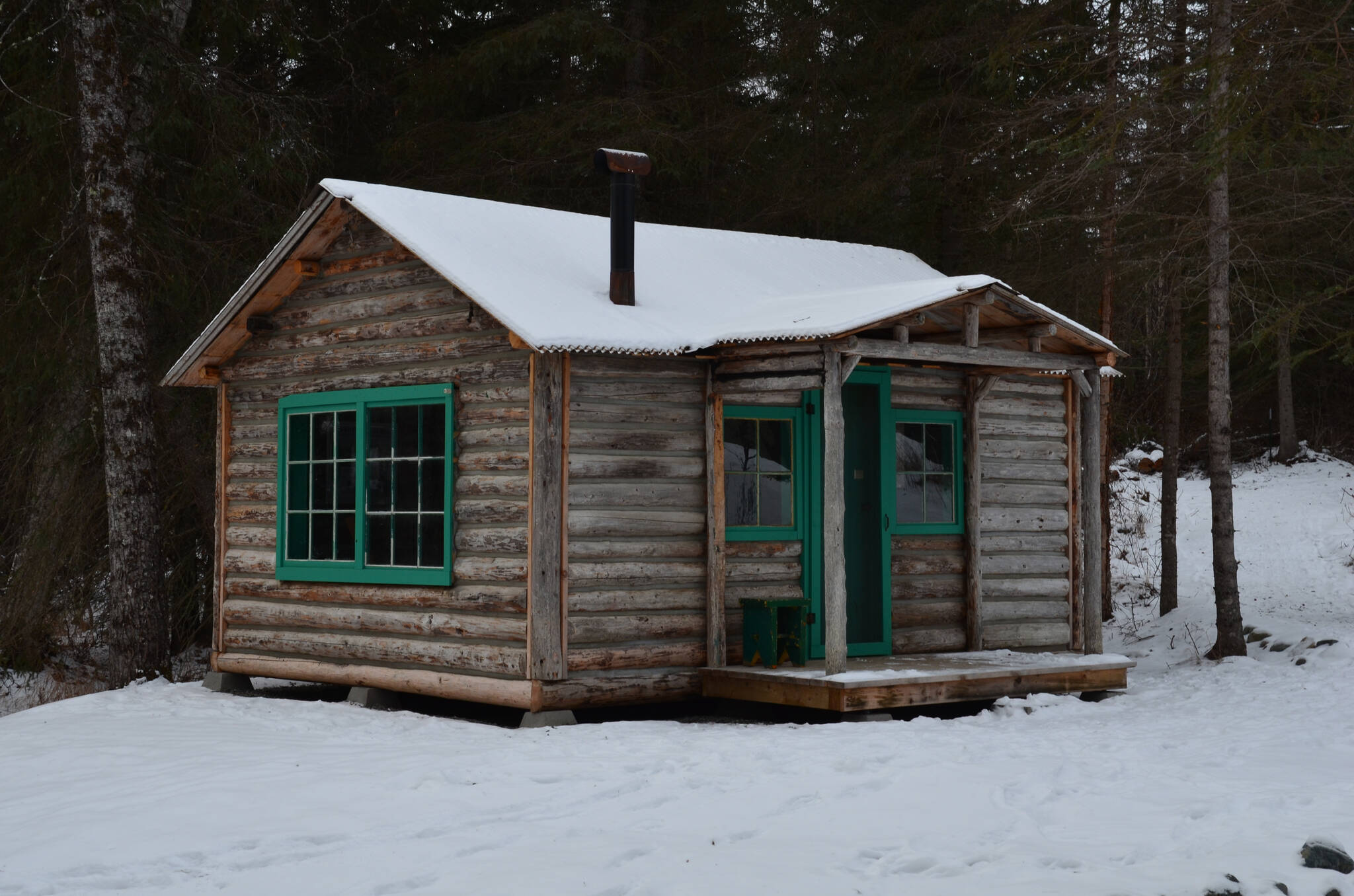
My first encounter with Kenai National Wildlife Refuge cabins was as a Youth Conservation Corp leader in 1984 (41 years ago). The refuge manager assigned us a project to dismantle the Hidden Creek Cabin near the junction of Hidden Creek and Skilak Lake. We repurposed the logs and boards from the cabin to build a “corduroy” boardwalk to cross a boggy section of the Hidden Creek Trail.
At the time, many viewed the Hidden Creek Cabin as an attractive nuisance that drew partying groups who had repeatedly vandalized it. Its original use as a shelter cabin for boaters to wait out storms on Skilak Lake had diminished due to the Great Alaska Earthquake of 1964, which caused the ground to drop and subside several feet, creating a soggy, buggy landscape. At the time, no one had thought to disassemble and relocate the historic cabin to another locale where recreationists could use it.
After we finished the project, I met Gary Titus, a game warden with Alaska Fish & Wildlife Protection. Somehow, the subject of dismantling the Hidden Creek Cabin came up, and he said, ” So you’re responsible for destroying an important part of our history?” Well, that certainly gave me food for thought.
Fifteen years later, the refuge hired Gary as a backcountry ranger. His primary purpose was to develop a recreational cabin program, restore historic cabins, and build new log kit cabins to enhance the refuge’s recreation program. He also became our de-facto historian and worked to preserve historic cabins throughout the refuge and for other resource agencies in Alaska and even as far away as Kofa National Wildlife Refuge in Arizona.
My outlook on historic cabins has also evolved over this time. I was delighted when two cabins in remote locations were reassembled at the Kenai National Wildlife Refuge Headquarters and Visitor Center Complex.
The first, in 2000, was the relocation of the Andrew Berg Homestead Cabin from Tustumena Lake to an area adjacent to the Refuge Headquarters and Environmental Education Center.
The second, in 2014, was the relocation of Elwell’s Fishing Lodge guest cabin from Upper Russian Lake to an area adjacent to the new Refuge Visitor Center. These two cabins have fascinated locals, students and visitors, and helped bring bygone eras to life.
Not all cabins are easy to visit and experience firsthand. Harder still is learning of the cabin’s history and the fascinating people who built them. But their stories can come to life through a compilation of stories.
Fortunately, a book now brings the cabins to those who would not have the chance to see them or those who have but didn’t fully understand their history.
In addition, you will discover the refuge’s history and the changing attitudes toward preserving historic cabins over the decades.
I enjoyed a multitude of wonderful historical photos — especially the photo of Steve Melchior feeding his pet moose and of Hjalmar Anderson’s homemade windmill on Caribou Island in Skilak Lake.
Excellent maps locate the variety of cabins by use — early people, trapping, mining, recreation, etc. For the first time, fascinating historic maps from private collections are also available to a wider audience.
Whether we stay in one of the cabins or read about them, most of us will find connections through our curiosity to know more about a particular cabin. Others may surprisingly find connections to one of the historic people in the book. A tremendous wealth of our local history is captured in one unique, entertaining work. We are fortunate to have such a comprehensive resource available for our local area.
Candace Ward worked for 33 years as a refuge park ranger, with her last position as information and education program supervisor, and retired in 2017. She enjoys recreating on the refuge and learning about its human and natural history. Please join Gary Titus and Clark Fair for a presentation and book signing, “A Vanishing Past — Historic Cabins of the Kenai National Wildlife Refuge,” at the Refuge Visitor Center on May 6, at 5:30 p.m.
