
Editor’s note: This article has been updated to show that the new regulations on the refuge only include a “no wake” restriction on some lakes in the refuge, not all waters.
Visitors to the Kenai National Wildlife Refuge will have a few more regulations to follow this summer.
The U.S. Fish and Wildlife Service issued its final rule update for public use regulations on the refuge on May 5, effective 30 days later on June 5. The ruling applies across the nearly 2 million-acre refuge and changes some of the access policies on camping, gun use and boat use.
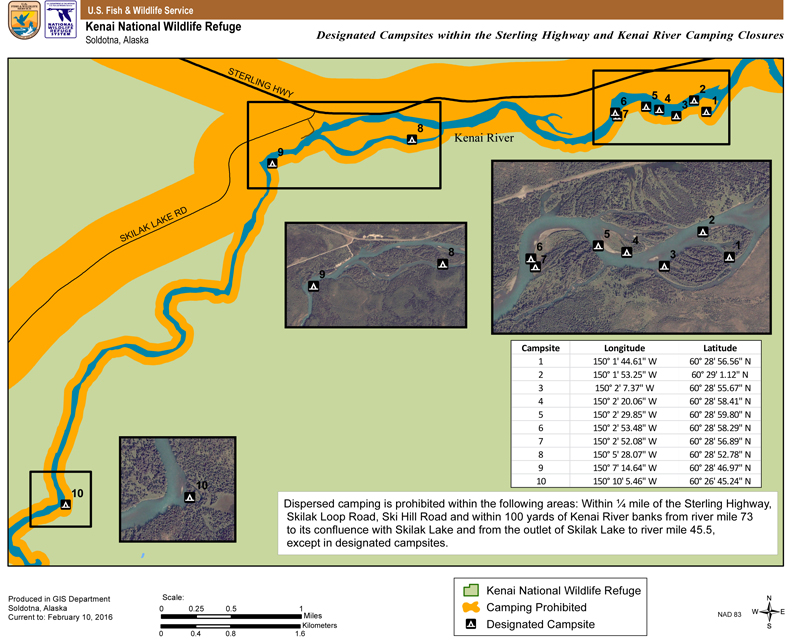
One immediate change dictates where people can camp along the Kenai River between river mile 73 to its confluence with Skilak Lake and from the outlet of Skilak Lake to river mile 45.5. Traditionally, people have camped along the banks throughout the area, but now they will be restricted to either camping more than 100 yards from the shorelines or in one of 10 designated campsites along the river.
The camping pressure has caused damage to the vegetation and bank stability over the years, said Matt Conner, visitor services manager for the refuge. Refuge staff surveyed the area and picked 10 spots hardened enough to support the camping without incurring more damage, he said.
“Other spots folks have been using historically is really damaging the vegetation,” Conner said. “This was an effort to kind of pick the ones we thought (were) where we’d allow this because we still wanted to provide some of that opportunity.”
This weekend will likely see a large number of visitors to the refuge because the Russian River will open for sockeye salmon fishing, along with a number of other flowing waters on and near the refuge. Conner said there will be workers at Sportsman’s Landing and the Russian River Ferry with maps of where camping on the riverbank is allowed and notices will be posted at Jim’s Landing and Sportsman’s Landing.
The original rule included restrictions to the middle Kenai River within the refuge, but the final rule removed the restriction for that area. Instead, Fish and Wildlife will continue to coordinate with the state to manage that part of the river and will monitor effects of the camping restriction along the upper river, according to the final rule.
Another change will formalize how far someone can keep fish or a backpack from their person. The refuge has issued temporary restrictions for the last few years on food and retained fish storage to prevent human-bear interactions near the Russian River and Kenai River confluence. The U.S. Forest Service manages the other side of the river and has the same regulations in place; the changed restrictions will bring the two into alignment, Conner said.
Visitors must keep fish within 12 feet and other attractants — food, beverages or garbage — in a bear-resistant container, in a vehicle or within three feet of the owner at all times.
“They’re pretty savvy animals, and they get habituated to people,” Conner said. “That’s kind of a scary situation to be in.”
Another part of the final rule changes some hunting restrictions. Hunters cannot take brown bears over bait on the refuge after the rule goes into effect and cannot discharge a firearm within a quarter-mile of the Kenai and Russian rivers unless they are dispatching an animal they have legally trapped or shooting for waterfowl or small game along the Kenai River. The rivers are so crowded with sportfishermen throughout the season that shooting causes a public safety hazard, according to the rule.
“These river corridors receive intensive recreational use for sport fishing from shorelines and boats during open seasons for salmon and resident fish including rainbow trout and Dolly Varden, and, on the upper Kenai River for river floating, from late spring to freeze-up,” the rule states.
The regulations also sync up the refuge’s requirements with the state’s restriction on horsepower and the four-stroke engine requirement. Originally, the proposed rule had placed a cap on engine horsepower on the some lakes on the refuge, but the rule was removed, leaving only the “no wake” rule in place, Conner said. As of June 5, a “no wake” restriction is in place on the entire water bodies of Engineer, Upper and Lower Ohmer, Bottenintnin, Upper and Lower Jean, Kelly, Petersen, Watson, Imeri, Afonasi, Dolly Varden, and Rainbow lakes. On other lakes, there are no horsepower or wake restrictions.
The full ruling is available on the federal register at https://www.federalregister.gov/articles/2015/05/21/2015-12099/refuge-specific-regulations-public-use-kenai-national-wildlife-refuge#h-11.
Reach Elizabeth Earl at elizabeth.earl@peninsulaclarion.com.
