
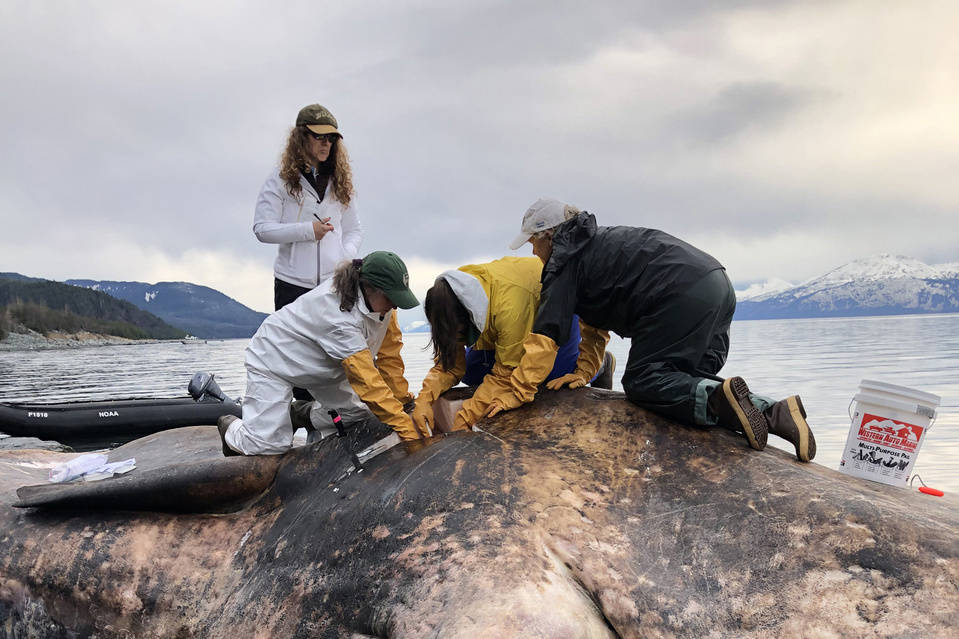
As soon as she walked up to the whale, Kate Savage could tell how it died.
There were three deep, long parallel slices just in front of the sperm whale’s dorsal fin. Savage, a veterinarian for the National Oceanic and Atmospheric Administration, knew that meant a propeller had sliced into the great mammal.
What was tragic for the whale ended up being advantageous for Savage and other Alaska scientists.
The 48-foot long male sperm whale ended up washing up on a beach near Berners Bay in mid-March. On March 20, Savage and her colleagues began just the third sperm whale necropsy ever to be done in Alaska, and the first to ever be done in Southeast.
“It was pretty unexpected, and very exciting,” Savage said in a phone interview Friday.
Only two other sperm whales have been necropsied in Alaska since 1990, according to a NOAA article published this week. The first was a partial necropsy of a whale in Resurrection Bay in 2006, the second was a calf near Homer in 2009.
[Scientists: Southeast Alaska vulnerable to ocean acidification]
Sperm whales are rare in the Inside Passage, but Savage said there were reports in November and early March of sperm whales in the Inside Passage. It’s not clear if this whale was one of the ones sighted earlier, she said.
Savage led a team of 13 people from NOAA, the Alaska Department of Fish and Game, the University of Alaska and Stranding Network (a nonprofit that focuses on marine mammals who have washed ashore). When they started the necropsy March 20, the researchers and volunteers wanted to collect as many samples and as much tissue as they could.
They knew they only had so much time to collect valuable samples, Savage said, as the whale was already fairly well decomposed. She said that whales have so much insulation that after they die, their interior organs “cook inside,” so it’s difficult to get a fresh and accurate look inside a dead whale’s body.
They were particularly interested in the leviathan’s stomach, to see if it contained concerning amounts of plastic or large amounts of sablefish. Increased amounts of plastic in the ocean have been killing sea creatures, and sperm whales have gained a somewhat notorious image for preying on sablefish in large numbers, Savage said.
They didn’t find plastic or sablefish in the stomach, Savage said, but they found numerous squid beaks. Members of the team were pleased to not find any plastic. Many fishermen have reported seeing magister armhook squid in Lynn Canal, according to the NOAA article.
Other intriguing finds, Savage said, included a large area of globular fat attached to the sternum and bumpy areas in the animal’s skull in places they didn’t expect to find them. They’ve now sent samples they took to sperm whale experts to get their thoughts on the find.
Savage admitted that with so few sperm whales up here to examine, she and the other researchers weren’t quite sure what was rare and what was normal.
“It really is going to be a good way to extend our knowledge, our personal knowledge of sperm whales and sperm whale anatomy and what to expect next time,” Savage said. “Who knows when that will be? But at least we’ll be prepared.”
[Former Rep calls attention to ‘frightening’ state of oceans]
The second time the researchers came back, about a week later, they found that someone had come and stolen the whale’s jaw. Sperm whale teeth, Savage said, are coveted. Raiding a sperm whale’s body is also illegal, as the animal is endangered.
NOAA encourages the person who took the jaw to return it, and anyone who has knowledge of who might have taken it are asked to call the NOAA Office of Law Enforcement’s 24-hour hotline at (800) 853-1964 or the Alaska Division at (907) 586-9329.
This particular whale was spotted when a pilot was flying over the area, Savage said. If others see a marine mammal washed up on shore, they’re asked to call the NOAA Fisheries 24-hour hotline at (877) 925-7773.
As for the whale, he’s still resting on the beach near Juneau. Savage said she hopes animals in the area can get some use out of the whale before it wastes away completely.
“If it’s lying on the beach like that, then it’s OK to collect what we need to and let the various scavengers collect some energy from it.” Savage said. “I’m hoping there are some bears that see that guy and use some of that.”
• Contact reporter Alex McCarthy at amccarthy@juneauempire.com. Follow him on Twitter at @akmccarthy.
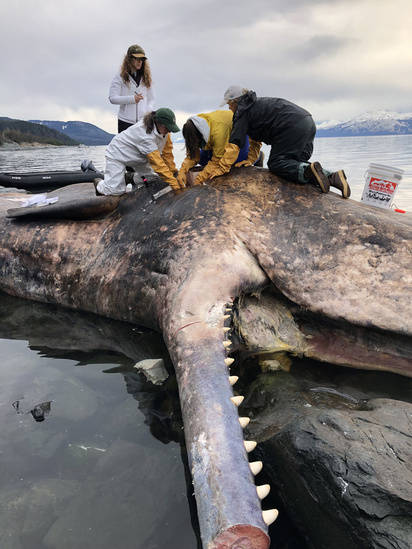
A team of marine mammal experts performs a necropsy on a male sperm whale. (Courtesy photo | Johanna Vollenweider, NOAA)
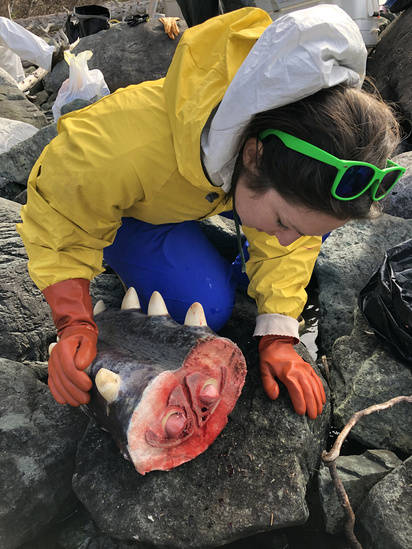
The team collected the whale’s teeth to determine age, blubber to check for contaminants, and a variety of tissue samples to enable future studies, and understand factors that contributed to the whale’s death. (Courtesy photo | Johanna Vollenweider, NOAA)
