
Hundreds of people testified on Tuesday in support of the ferry system. Many fear it will shut down after Oct. 1.
The people’s fears aren’t coming out of nowhere. People are looking for scenarios that could keep the ferry system open past the October deadline the governor has proposed in his fiscal year 2020 budget.
As it stands, the ferry system is facing a $97 million cut — 75 percent of its budget — under Gov. Mike Dunleavy’s proposed budget for fiscal year 2020. The ferry system may only operate seasonally instead of year-round. The Alaska Marine Highway System has already stopped taking reservations after Oct. 1.
[Frustrations run high as many testify in support of ferry system]
Many who testified Tuesday said just the prospect of closing the system in October has already began to hurt them. One tour business operator said she relies on the reservation system to help customers book travel. So even though nothing has been finalized regarding how much or how little the ferry system will run after the summer season, people are already feeling the effects.
But, Dunleavy’s office says stopping service in October isn’t the end goal.
“There’s been a lot of focus about the end goal here — the need to reform the system and reshape the system to make it work in a way that works for Alaskans,” said Matt Shuckerow, Dunleavy’s press secretary, in an interview with the Empire. “I don’t think the governor is saying wholesale eliminate the ferry system altogether, he’s saying we need to find a way to make it work.”
Searching for scenarios that could extend service past October
At a Tuesday presentation by the Office of Management and Budget and the Department Of Transportation & Public Facilities, directors from these agencies outlined three possible future scenarios for the AMHS.
Each of the three scenarios proposes extending service past Oct. 1, but at a price. Each option proposes reducing sailings or cutting service to certain ports like Prince Rupert, Angoon, Tenakee Springs and Pelican. All scenarios rely on the “fare box recovery rate,” which is the fraction of operating costs that are covered by passenger fares.
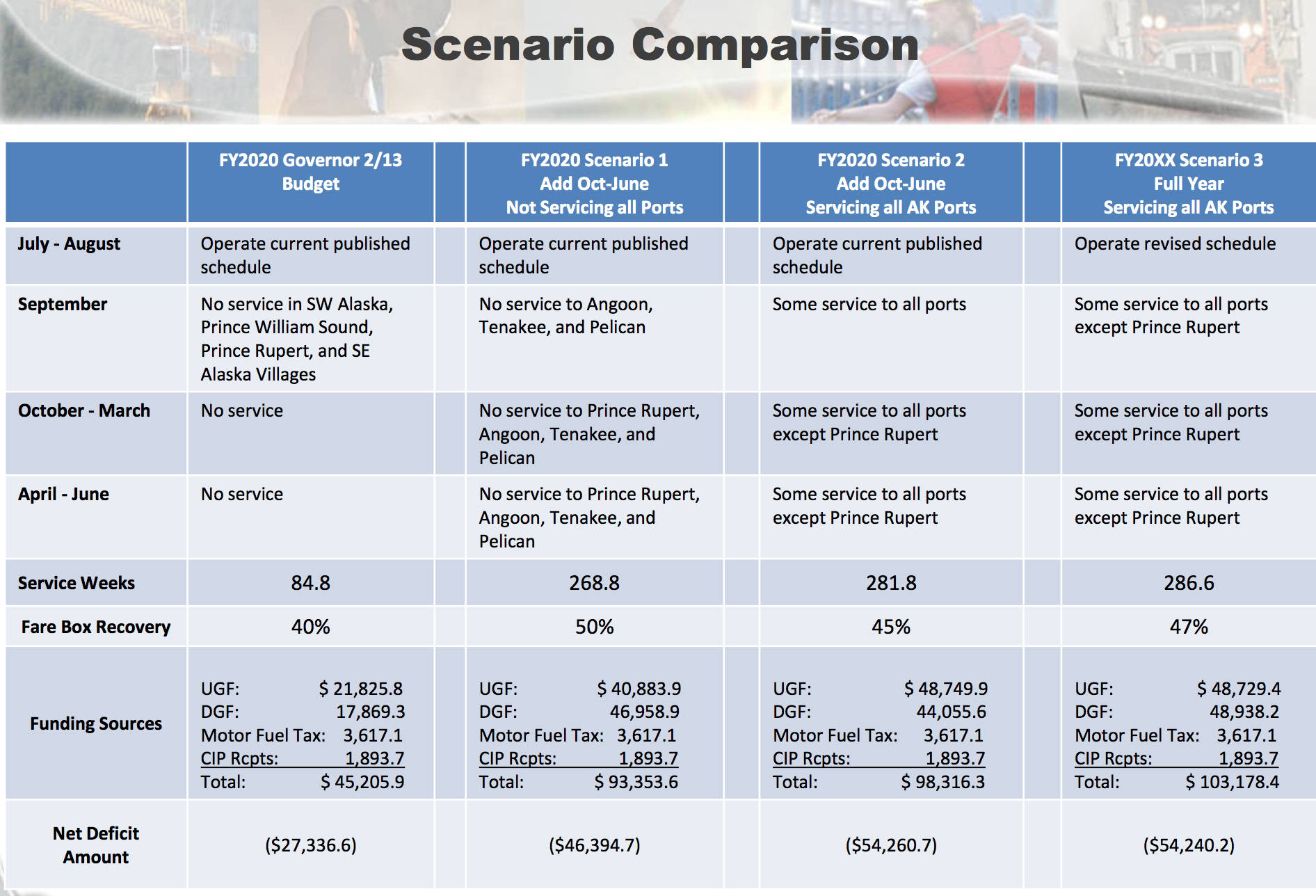
But legislators say these are just options, and some plan to produce another plan besides these three.
“These scenarios were created by the (Dunleavy) administration, and the Legislature is not limited to select from only these options,” Rep. Louise Stutes, R-Kodiak, told the Empire in an email. “I certainly intend to use my position as the Co-Chair of the House Transportation Committee to ensure coastal Alaskans get basic service.”
She said the three scenarios presented by the governor’s office were “unreasonably fixated on the fare box recovery rate” and that the fare box recovery rate in Alaska is excellent compared to other ferry operations around the world. The AMHS fare box recovery rate has hovered between 30 and 35 percent from 2007 through 2018, according to the OMB presentation.
The three scenarios proposed by the OMB all predicted fare box recoveries between 40 and 50 percent.
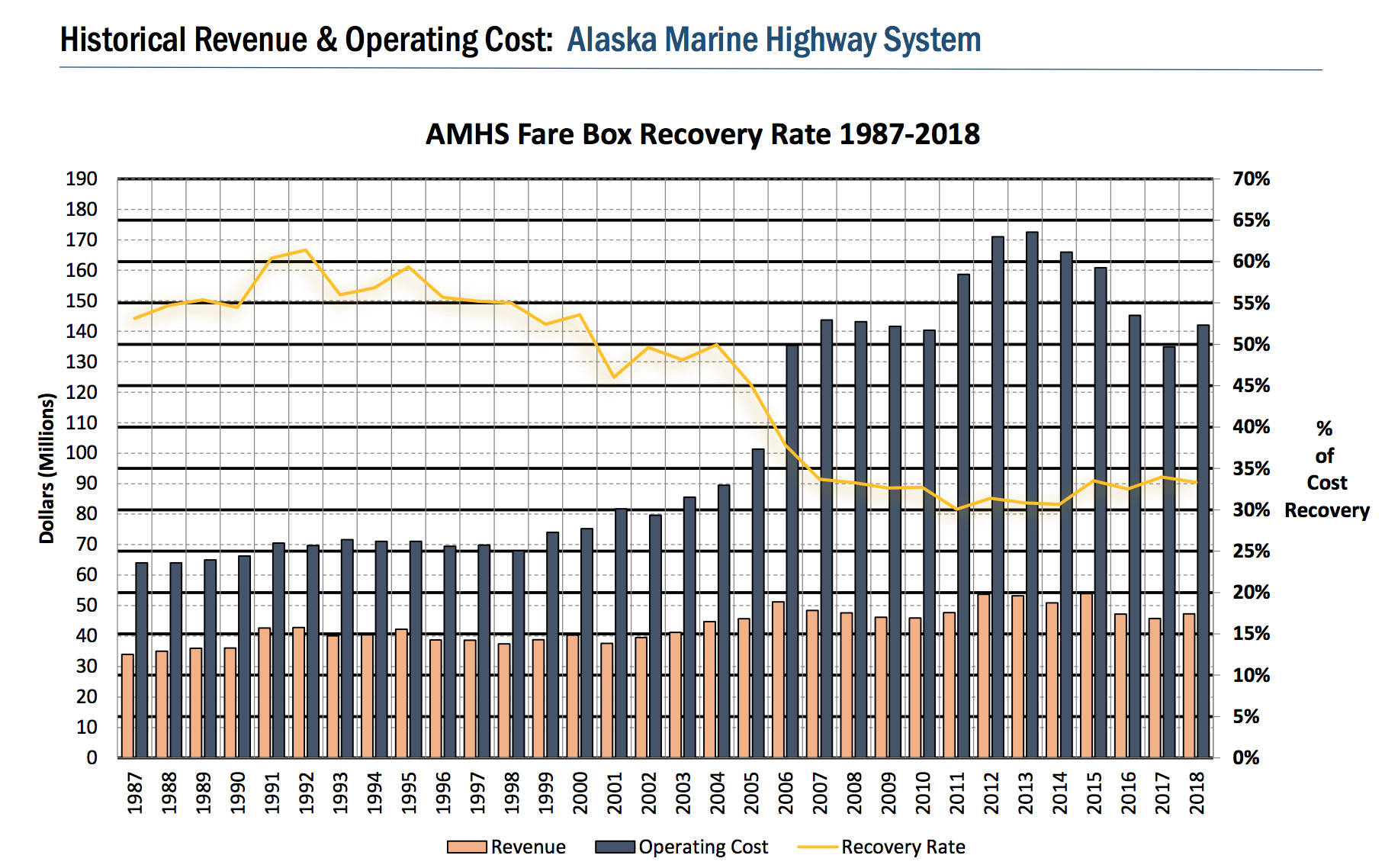
This graph shows the fare box recovery rate for the Alaska Marine Highway System. (Courtesy)
“Additionally, even if the ships operated at full capacity all year, and we generated as much revenue as possible, no routes would come close to a 100 percent fare box recovery,” Stutes said.
The AMHS Reform study found that there are no operating scenarios where AMHS can recover its operating costs through the fare box and still fulfill its critical public service mission.
Earlier this week, Senate Democrats said they were worried about what would happen to AMHS assets like ferry terminals and boats if the ferry system were to stop running.
“When the marine highway system came in front of the Senate Finance committee, it became evident that they were not going to get any more money, and that was stated very bluntly,” said Sen. Donald Olson, D-Golovin, at a Monday press conference. “What are your plans to go ahead and keep them so that one, they maintain their Coast Guard certification?” He said the OMB didn’t have answers to that.
Total AMHS assets are worth about $1.1 billion, Shuckerow said, with the breakdown of that being about $1.067 billion in vessels and approximately $47 million in facilities (terminals, docks, etc.). This initial estimate does not include all assets, such as spare parts for ferries, he said.
Stutes said it wouldn’t make much sense to sell any of the marine highway assets, and that she asked DOT&PF Commissioner Designee John MacKinnon on March 7 to provide information regarding the liabilities Alaska would hold if any assets were sold.
“I expect we would have to pay quite a bit back to the federal government if we decided to abandon the assets they helped us purchase,” Stutes said. She’s still waiting to hear back from MacKinnon on the specifics.
Dunleavy’s main goal right now is to wait for the upcoming report by a yet-to-be-hired consultant that he hopes will provide direction, Shuckerow said.
“Of course we’re going to wait until a report that outlines the different proposals, options and different things that are available to discuss, but ultimately the governor is going to take look and make an assessment based on the recommendations of this,” Shuckerow said.
Some critics say there has already been enough assessment done on the ferry system. The AMHS Reform initiative is a statewide collaboration of stakeholders, including businesses, communities and tribes seeking to reform and revitalize the state’s ferry system in order to improve its efficacy and ensure its long-term sustainability. The effort is managed by Southeast Conference and led by a 12-member steering committee.
The board has been commissioning studies on the ferry system by economic analyst firms, McDowell Group and Elliott Bay Design Group since 2016, producing recommendation reports in 2016 and again in 2017 to remove the system from the DOT&PF, and create a state-owned corporation, like the Alaska Railroad.
“(DOT&PF and AMHS) should be two different entities, because … we get x amount of dollars from the feds,” said Timothy Lindoff, Juneau resident and former employee for the AMHS. “They should be looking at our past employees like the people who are deckhands, and oilers, that really know the marine highway … to run the Alaska marine highway, someone that knows the water.”
Members of the House Transportation and Public Facilities committee said in a meeting Tuesday that only one application was received for the governor’s consultant position. That has some worried.
“Due to a conversation with the department, I am under the impression that several parties sent inquiries, but only one application was received,” said Stutes. “I look forward to the Department disclosing the name of the chosen bidder and the names of the other parties who expressed interest.”
She said the department stated in an email that they can’t disclose the name of the selected applicant until they issue a Notice of Intent to Award to that selected bidder around March 18.
Stutes said she would be interested to hear from parties who were not able to apply in the unusually short period of five days.
“We do not need to spend more money on yet another consultant,” Stutes said. “The State of Alaska has paid for many studies over the last 20 years that consistently tell us the same thing: The Alaska Marine Highway is vital to our economy.”
Ferry facts
AMHS accounted for 1,700 Alaska jobs and $104 million in Alaska wages and benefits in 2014, according to a 2016 AMHS Reform committee report. AMHS residents reside in 44 different Alaska communities. It also contributes to a wide variety of businesses and resident activity. AMHS spent $84 million with over 500 Alaska businesses to support operations, the study found.
The chair of the committee, Rep. Adam Wool, D-Fairbanks, also pointed out at the meeting yesterday that the governor’s directive does not include consultation with the Marine Transportation Advisory Board, which is required by Alaska statute.
The state still owes money for the two studies produced by the AMHS reform committee, said Stutes. One of her staff members estimated that it was somewhere around $60,000, but exact numbers were not available by deadline for this article.
“Why are we promising more money to yet another consultant to consider a study produced by consultants we still owe money to?” Stutes asked.
When asked to respond to the governor’s statement that he’s not looking to “wholesale eliminate” the ferry system, Stutes said, “The budget bill says the balance of the funds will be transferred to dismantle the marine highway system. The language is clear – Gov. Dunleavy is moving funds to divest the marine highway.”
Public testimony on the ferry system will be taken again Thursday from 1:30 to 3 p.m.
• Contact reporter Mollie Barnes at mbarnes@juneauempire.com.
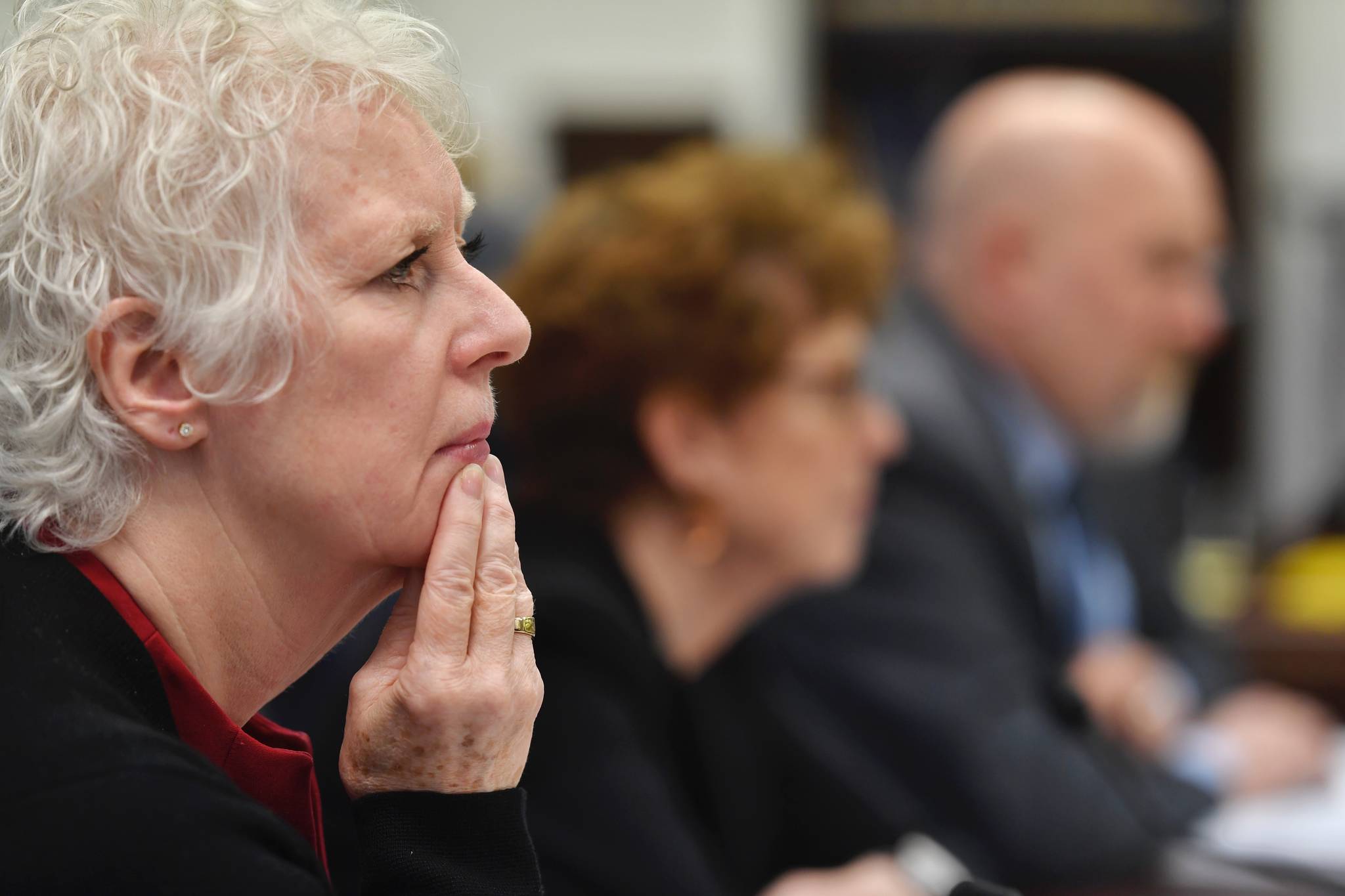
In this file photo, Rep. Louise Stutes, R-Kodiak, listens in a House Labor and Commerce Committee on Wednesday, March 6, 2019. (Michael Penn | Juneau Empire)
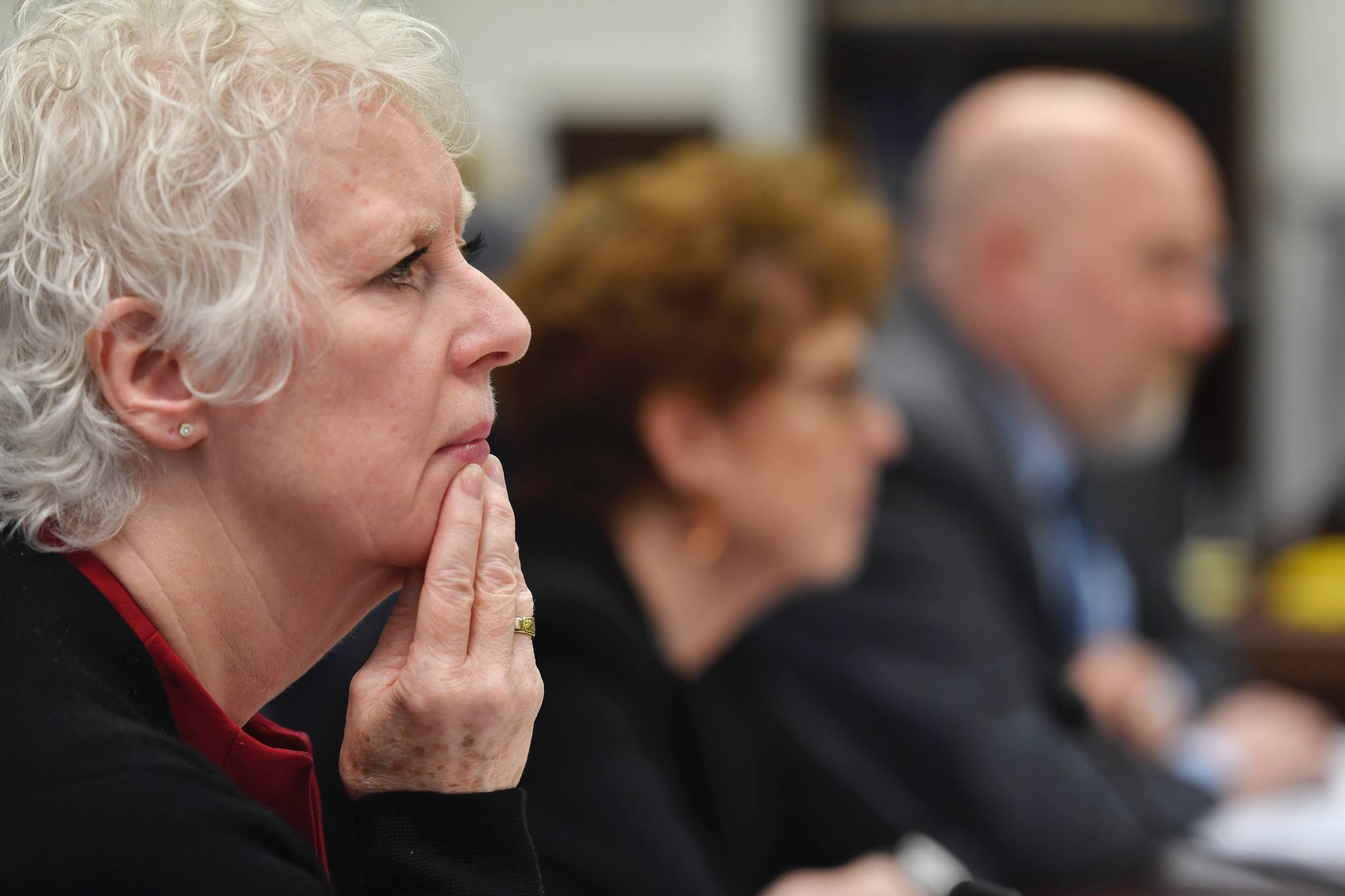
In this file photo, Rep. Louise Stutes, R-Kodiak, listens in a House Labor and Commerce Committee on Wednesday, March 6, 2019. (Michael Penn | Juneau Empire)
