
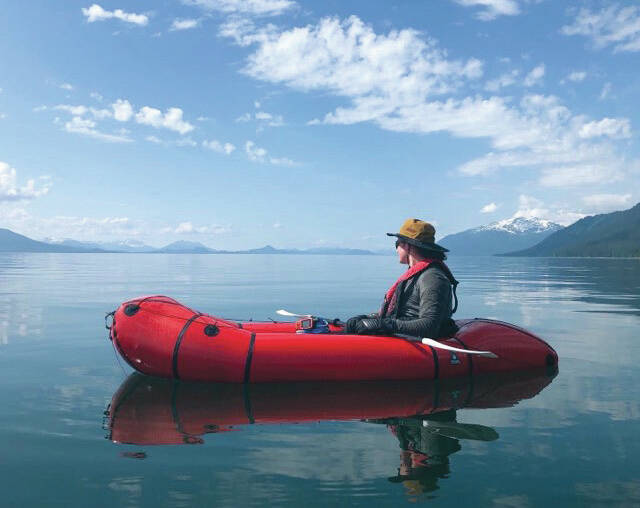
If you told Steven Ireland-Haight a year ago he’d be two months into a yearlong journey to cross the waters and land between Juneau and the nation’s capital, he probably wouldn’t have believed you. Yet, here he is.
“I wasn’t even sure I was going to make it this far,” he said by phone from a town in British Columbia.
Born and raised in Juneau, Ireland-Haight always had a love for the outdoors and spent much of his time in the capital city up in the mountains hiking and exploring the nature of Southeast Alaska.
He said that his love for the outdoors is what inspired him to start a journey traveling from Juneau to Washington, D.C., using only a kayak and his own two feet with a goal to spread more awareness about climate change along the way. He is sharing his story on social media and fundraising for Sunrise Movement, a youth movement with a goal to stop climate change.
“I’m doing this trip first for myself, but I also wanted to make it something that could have value beyond myself like advocating for climate change,” he said. “I care a lot about climate change and I’ve never gotten involved with any activism in it so I wanted to take a year to do something about it.”
Ireland-Haight is already more than two months into his trip, which he expects to last around a year. He said he is almost finished with the kayaking portion and is only weeks away from beginning the walking portion. In total, he is expected to cover around 4,700 miles before ending his trip to the nation’s capital.
The making of the trip
After graduation from Juneau-Douglas High School: Yadaa.at Kalé in 2019, Ireland-Haight moved to Phoenix, where he spent three years earning his bachelor’s in forensic psychology and criminal justice at the University of Arizona.
“Totally unrelated to the climate change stuff,” he said.
But, the thought of climate change never left his mind.
During the year and half of college, he realized he had a chance to graduate early and wanted to use the year between undergraduate and graduate school to do something not only for himself but for climate change.
“Once I realized that I could graduate early I decided, ‘OK, I’m gonna do it,’” he said. “I didn’t want to go straight into grad school or whatever else I’m planning on doing and I figured I had to do something that was for me.”
He spent that time planning the trip and working extra jobs to have enough money to sustain him over the trip. He worked at outdoor shops, and in the process, got “really good” discounts on nice gear that he knew he needed for a trip of this magnitude.
After graduating in May, he came back to Juneau and prepared to take off on the journey — though it didn’t start without a few hiccups.
A rough start
Ireland-Haight and a close friend — who did the beginning of the journey with him — wished Juneau farewell and hit the waters on June 15 with the plan to paddle and walk the Southeast coast until reaching Bellingham, Washington.
He soon realized a major flaw in his initial plan.
“I don’t really have kayak experience and made some bad choices, ” he said, laughing. “I basically started out thinking I would be able to do this in a packraft, like an inflatable raft. It was like 7 pounds, and I planned to be able to put it in my backpack while I hiked.”
The packraft proved to be much slower on the water than his friend’s kayak, and he only made it to Petersburg before he decided to ditch it in a trade for a kayak, which proved to be a pivotal decision for the trip.
“Looking back, I don’t know how I allowed myself to attempt to do it like that,” he said. “I didn’t know it was a terrible idea to bring a packraft, like honestly, it was a really really bad idea, like really bad because that thing was so freaking slow.”
But, after the initial “big whoopsie,” the trip seemed to be somewhat smooth sailing. His friend Owen Squires, a Juneau resident, rowed alongside him for the 250 miles it takes to kayak from Juneau to Ketchikan. Ireland-Haight’s father, Glenn Haight, said having his son start out with a friend gave him a peace of mind even though he can’t help but worry as his son takes on this adventure.
“It’s an adventure, but of course as a parent you get nervous,” he said. “But, if anything happened early on they had each other for a while which was nice.”
Haight said he is able to keep in touch with his son via the updates his son posts on his Instagram and YouTube accounts and a Garmin inReach, which Ireland-Haight uses to text his father every night. He said he thinks what his son is doing is “pretty cool” and something that most people would wish to do in their lifetime.
“I remember I wanted to go around the world when I graduated and I didn’t, but he’s actually doing something he wants to do,” Haight said.
Haight said he hasn’t been able to meet up with his son since he launched at the Mike Pusich Douglas Harbor in mid-June, but he hopes to meet up with him and walk a few miles together later in his journey.
Looking to the future
Ireland-Haight said he’s thinking of going to graduate school next fall, so he’s hoping to finish his trip before then and do it in around eight months. As he moves closer to the walking portion, and as the weather starts to turn toward fall and winter, he said it will be interesting to see how the trip plays out.
He plans on camping out throughout the journey and said he is a little nervous about the winter and said it will be difficult, but he is confident in his gear and ability to work around the adversity.
“Sometimes it can be a pain in the butt, but usually it’s not too bad,” he said.
So far he said the biggest thing he’s taken away from the trip so far is the amount of hospitality he has received from people he’s never met before, and the overwhelming support he’s had from people in Juneau and on social media.
“I’ve met so many random people that have been so awesome and so kind to me, and I think the people that I’ve met so far have been one of the coolest things,” he said.
He said he hopes his journey inspires people to be more aware of human impact on the environment and learn more about the importance of fighting climate change.
“It’s really interesting to see how humans create these spaces where there is really no space for natural life,” he said. “I’m really passionate about climate change and spreading awareness.”
Contact reporter Clarise Larson at clarise.larson@juneauempire.com or (651)-528-1807. Follow her on Twitter at @clariselarson.
