
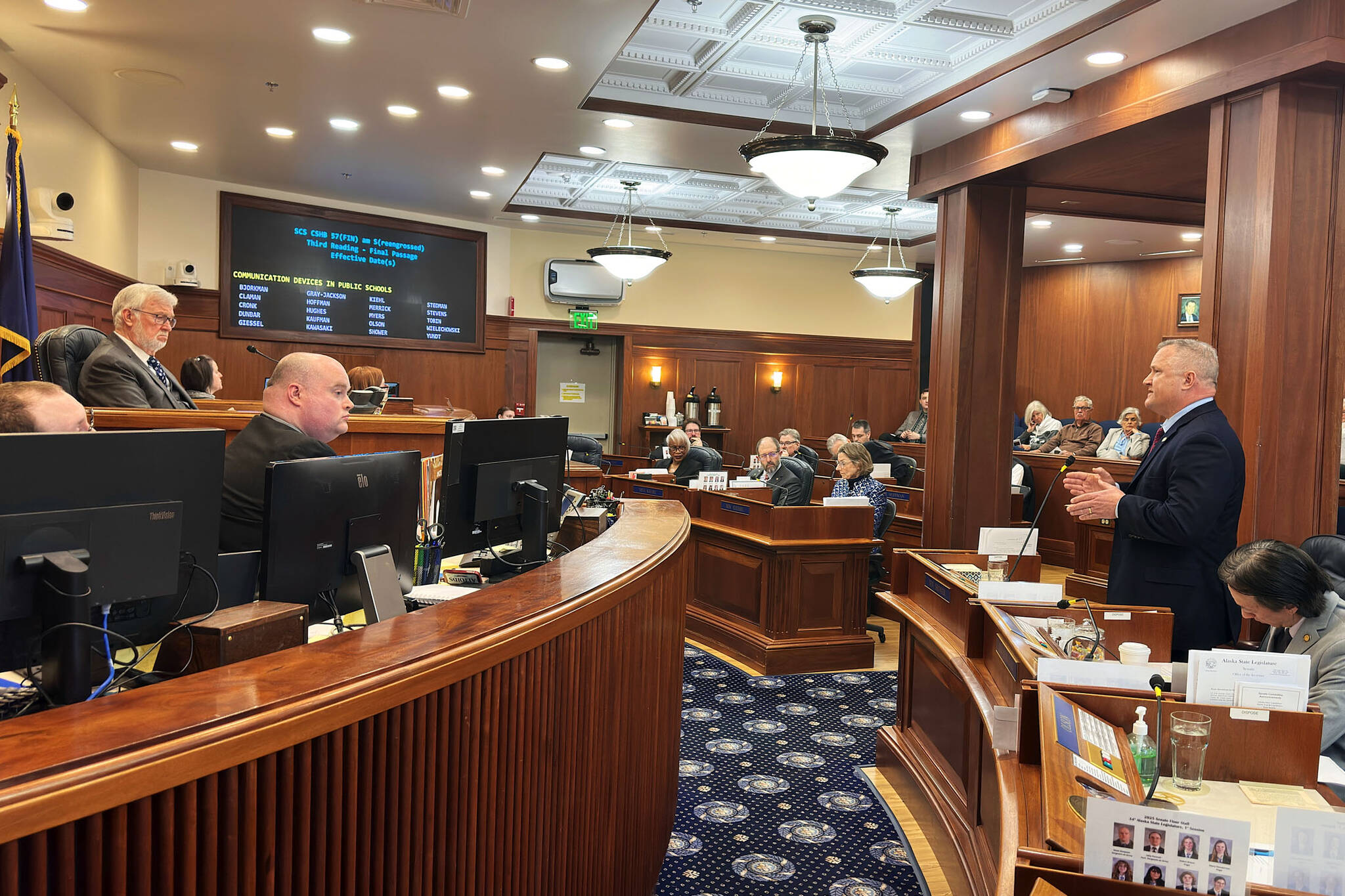
A compromise education bill again easily cleared the Alaska Legislature by a veto-proof margin Wednesday, but lost two Senate votes — including the minority leader’s — after Gov. Mike Dunleavy’s education commissioner on Monday sent school districts a threatening letter telling them to support his policy priorities or risk having education funding vetoed.
House Bill 57 passed the Senate by a 17-3 vote after some contentious discussion and the House by a 31-8 vote with no discussion other than an overview of its provisions by the sponsor. The 48 combined votes (which exclude an absent member of the Republican minority) exceed the 40 necessary for a veto override — or 45 if Dunleavy vetoes education-related funding in next year’s state budget.
“I think you see what was expressed by a bicameral, bipartisan sort of effort (is) that the Legislature took a while to actually get to a compromise,” House Speaker Bryce Edgmon, I-Dillingham, told reporters after the House floor session. “And I certainly salute all those that were involved in not only recognizing the fiscal reality that we’re in, but also that the policy measures had the accompanied the bill itself. We are going to get something through this year and we will override the governor if he chooses this time to — on a second occasion — veto the bill. I would hope … that the governor respectfully takes heed of the broad support behind the measure that just passed.”
HB 57, which originated as a bill placing limits on students’ cellphone use at school, now contains a broad range of additional provisions including a $700 increase in the statutory $5,960 base student allocation. It also includes some — not all — policies sought by Dunleavy including increasing student transportation funding and easing regulations for forming new charter schools.
The reading incentives also favored by Dunleavy provide school districts $450 for each student in kindergarten through grade six who reads at or above grade level, or demonstrates improvement. Funding for the incentive is contingent on passage of a bill — which passed the Senate earlier this month and is pending in the House — requiring companies to pay state income taxes on Alaska-related online transactions even if the businesses are located outside the state.
A bill with a $1,000 BSA increase passed the House by a 24-16 vote earlier this session. That bill was vetoed by Dunleavy two weeks ago and the Legislature failed by a 33-27 vote last week to override the bill.
The revised HB 57 passed the Senate on Monday by a 19-1 vote, but was sent back by the House the same day due to technical wording glitches needing correction.
Wednesday’s 17-3 vote saw three of the six Republican minority caucus members joining the bipartisan majority caucus in support. The two senators who changed their votes said it was due to concerns they weren’t aware of Monday about the provision in the bill tying reading incentives to the online tax bill.
“There’s some things that broke through yesterday (until) today that has made me kind of go back and forth on where I stand on this because I really do want this bill to pass and I think it’s a deal that we can strike today with where we are,” Senate Minority Leader Mike Shower, a Wasilla Republican, said during Wednesday’s floor debate. “But I have some concerns (that) I didn’t realize, frankly, when we voted on Monday.”
Ten of the 19 members of the all-Republican House minority caucus, including House Minority Leader Mia Costello (R-Anchorage) joined the mostly Democratic 21-member majority in voting for the bill.
The bill was expected to be transmitted to Dunleavy on Thursday. He has up to 15 days to sign, veto or allow the bill to become law without his signature. If he vetoes it the Legislature will have ample time before their scheduled May 21 adjournment to meet in joint session for an override vote.
Dunleavy has not stated if he will veto HB 57 in its current form. However, Deena Bishop, commissioner of the Alaska Department of Education and Early Development, sent a letter to school districts Monday stating the bill — and portions of the state budget funding education — may be vetoed unless four specific policy provisions favored by Dunleavy are included.
“Please prioritize reaching out to your House and Senate members as soon as possible,” she wrote. “A personal call or email stressing the importance of these reforms and their direct impact on your district will be highly effective.”
In addition to the reading incentives, Bishop said an education bill passed by the Legislature needs expanded enrollment options for students to attend schools outside their home district, increasing per-student funding for correspondence programs and further easing regulations on charter schools.
“If these critical reforms are not included, we risk repeating the challenges of previous years when the education bill — and its funding components — were vetoed. We also face the possibility that the funding element of the bill could be reduced or vetoed.”
Edgmon noted one of the items in HB 57 is establishing an education task force that will further study policy elements such as open enrollment and equity of education funding that the governor has cited among is goals.
Dunleavy has line-item veto authority in the budget and it takes a three-fourths vote of the Legislature to override such vetoes. Furthermore, school districts would be without those funds for the fiscal year starting July 1 until and unless an override occurs, either when the Legislature returns for its regular session next January or convenes a special session.
Rep. Rebecca Himschoot, I-Sitka and co-chair of the House Education Committee, said she was contacted by one superintendent of a district she declined to name who expressed support for the governor’s policy goals. But she noted district officials have been contacting legislators throughout the session and doesn’t believe Bishop’s letter altered anyone’s position on the bill.
Contact Mark Sabbatini at mark.sabbatini@juneauempire.com or 907-957-2306.
