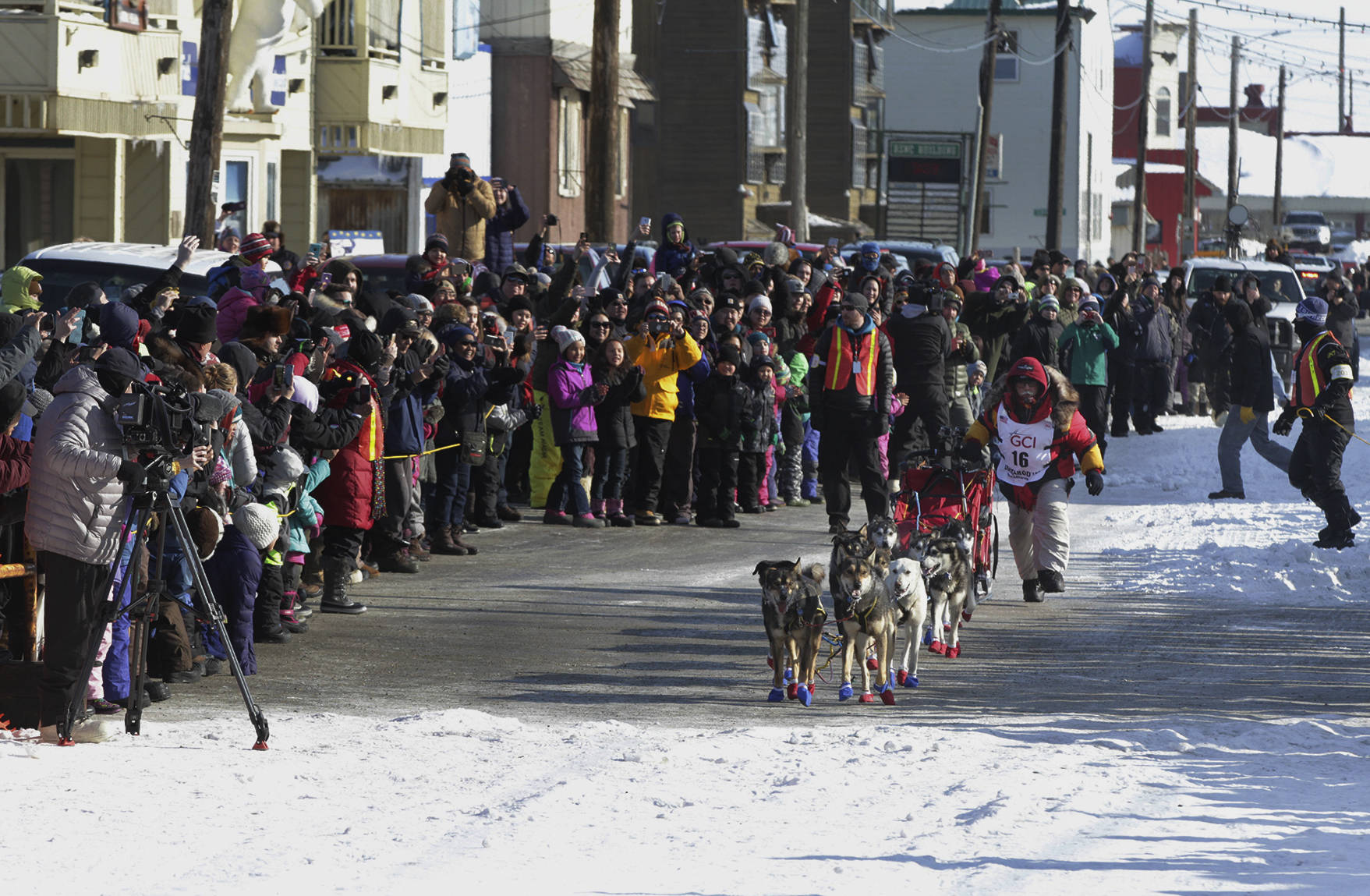
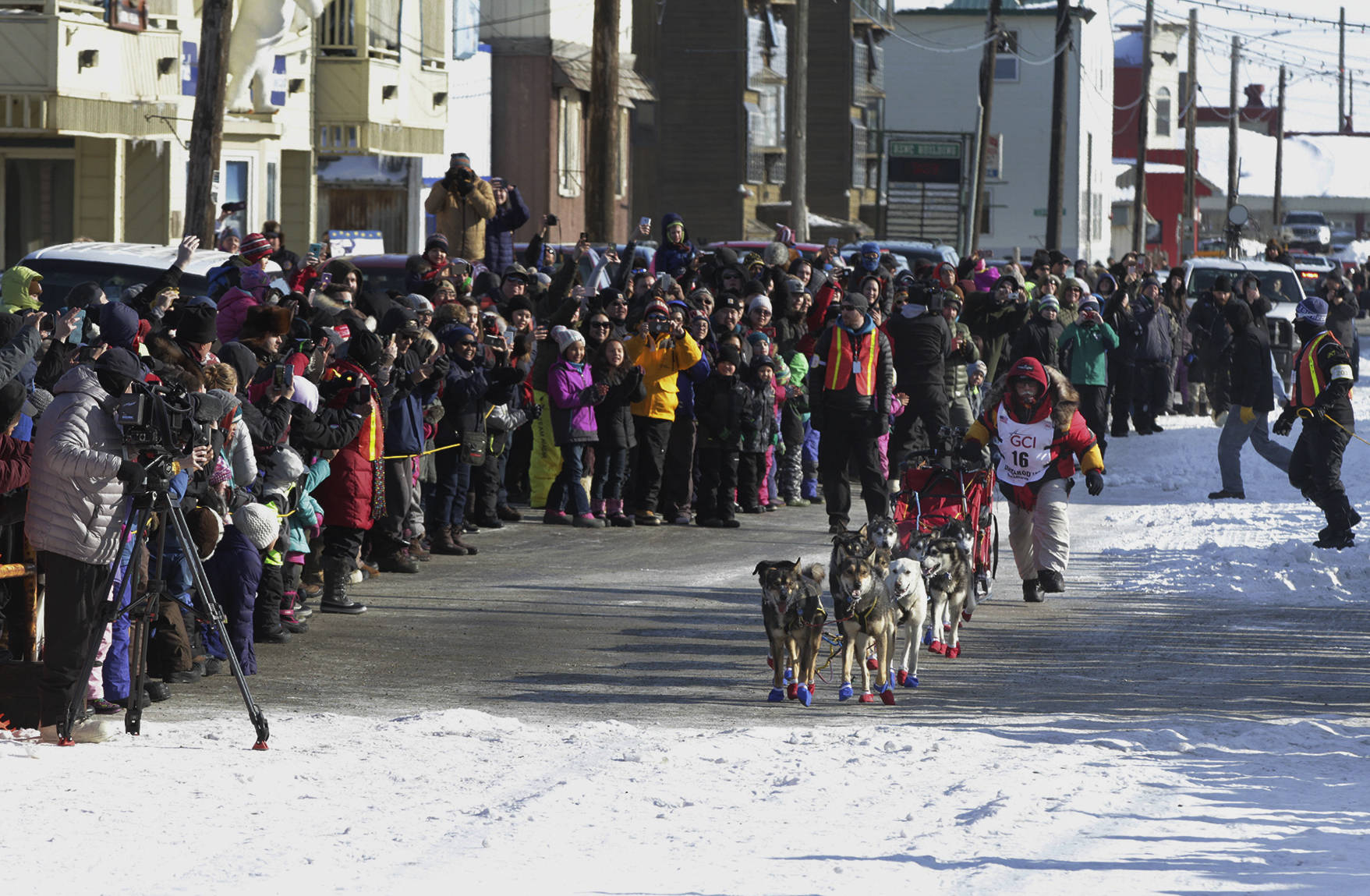
Mitch Seavey, of Sterling, Alaska, runs towards the finish line under the Burled Arch, winning the 1,000-mile Iditarod Trail Sled Dog Race, in Nome, Alaska, Tuesday, March 14, 2017. Seavey won his third Iditarod Trail Sled Dog Race on Tuesday, becoming the fastest and oldest champion at age 57 and helping cement his family’s position as mushing royalty. (AP Photo/Diana Haecker)

Mitch Seavey, of Sterling, Alaska, runs towards the finish line under the Burled Arch, winning the 1,000-mile Iditarod Trail Sled Dog Race, in Nome, Alaska, Tuesday, March 14, 2017. Seavey won his third Iditarod Trail Sled Dog Race on Tuesday, becoming the fastest and oldest champion at age 57 and helping cement his family’s position as mushing royalty. (AP Photo/Diana Haecker)

Mitch Seavey becomes oldest, fastest musher to win Iditarod

  • By Mark Thiessen
  • Tuesday, March 14, 2017 8:26pm
  • News

ANCHORAGE — Mitch Seavey won his third Iditarod Trail Sled Dog Race on Tuesday, becoming the fastest and oldest champion at age 57 and helping cement his family’s position as mushing royalty.

The Seward, Alaska, musher brought his dogs off the frozen Bering Sea and onto Front Street in the Gold Rush town of Nome after crossing nearly 1,000 miles of Alaska wilderness.

He outran his son, defending champion Dallas Seavey, and lapped the oldest musher record that he set at age 53 in 2013. He previously won the race in 2013 and 2004.

Seavey also set a time record of 8 days, 3 hours, 40 minutes and 13 seconds, the Iditarod said. That shaved several hours off the record his son set last year: 8 days, 11 hours, 20 minutes and 16 seconds.

“Sweet” was the first thing Mitch Seavey said after getting off the sled at the finish line under the famed burled arch. It was broadcast live statewide.

His wife, Janine, greeted him with a hug. “Oh, my gosh, look at what you’ve just done,” she told him. “You’ve changed the sport.”

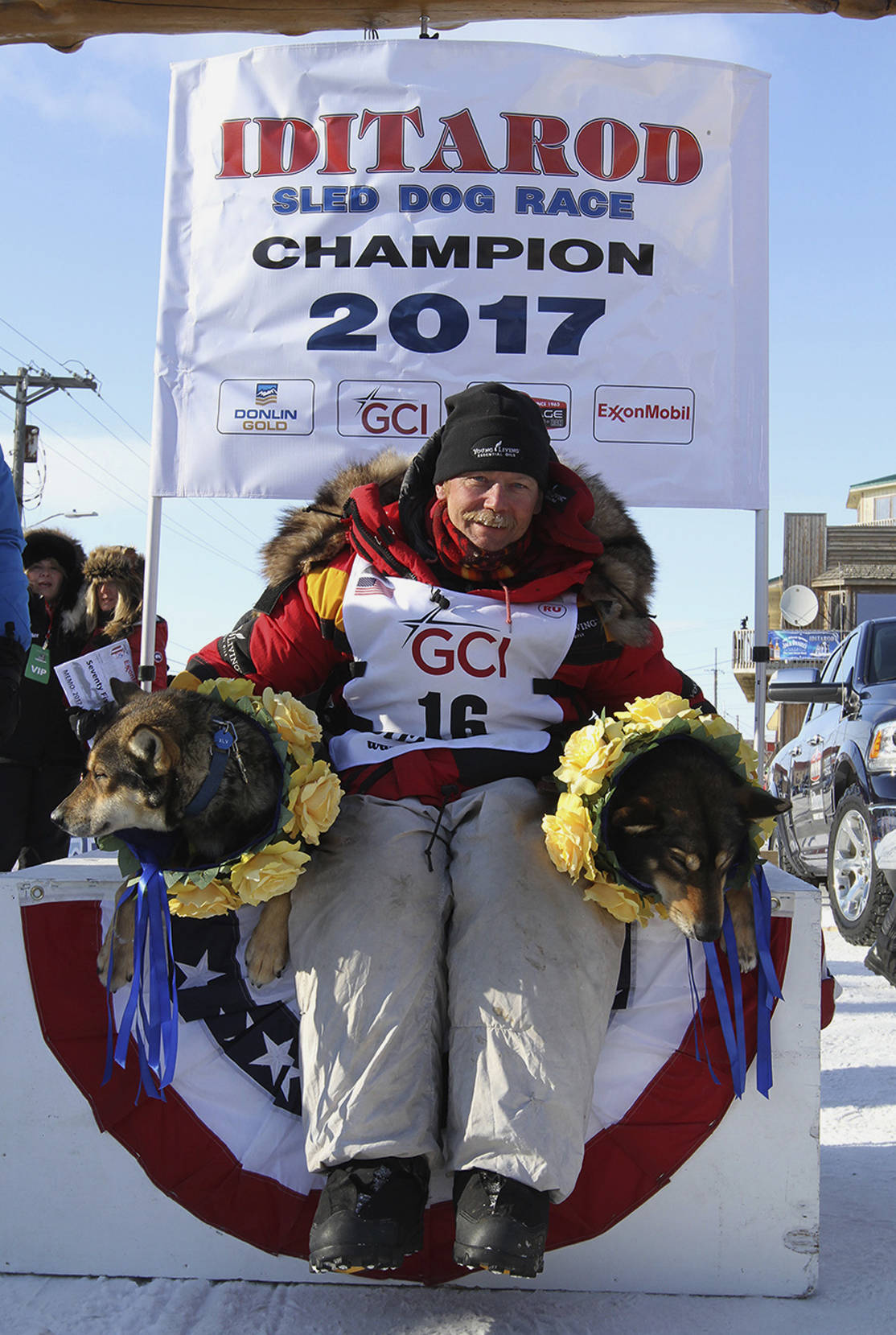
After talking to his wife, Seavey greeted each of his dogs and thanked them with a frozen snack. He later posed with his two lead dogs, Pilot and Crisp.

“They get frustrated when they go too slow, so I just let them roll, which was scary because I’ve never gone that fast, that far ever, but that’s what they wanted to do,” he said.

Seavey said the dogs know only one thing — 9½ to 10 mph.

“They hit their peak, they hit their speed, and that’s what they do,” Seavey said at the finish line. “They trusted me to stop them when they needed to stop and feed them, and I did that, and they gave me all they could.”

Seavey picked up $75,000 and the keys to a new pickup truck for winning the world’s most famous sled dog race.

The Seaveys have now won the last six races. Dallas Seavey won four, and his father finished second the last two years. The two are close but competitive.

“He and I have such a great relationship,” Mitch Seavey said. “There’s no malice, we just love running sled dogs. No question.”

Dallas Seavey finished in second place, five minutes ahead of France native Nicolas Petit.

The family’s ties to the race go back to the first Iditarod, held in 1973, when Mitch Seavey’s dad, Dan, mushed in the event. The younger Seavey, who is 30, had wins in 2012 and from 2014 to 2016.

The race started March 6 in Fairbanks, with 71 teams. Five mushers scratched.

Fans lined the finish, clapping and cheering on Seavey. As his team finished the last few blocks of the race, Seavey yelled, “Good boys! Hep!”

Just before reaching the chute, he got off his sled and ran with the dogs a bit.

Four dogs associated with the race have died this year, including a 4-year-old male named Flash who collapsed on the trail early Tuesday when his musher, Katherine Keith, was about 10 miles outside the checkpoint in Koyuk.
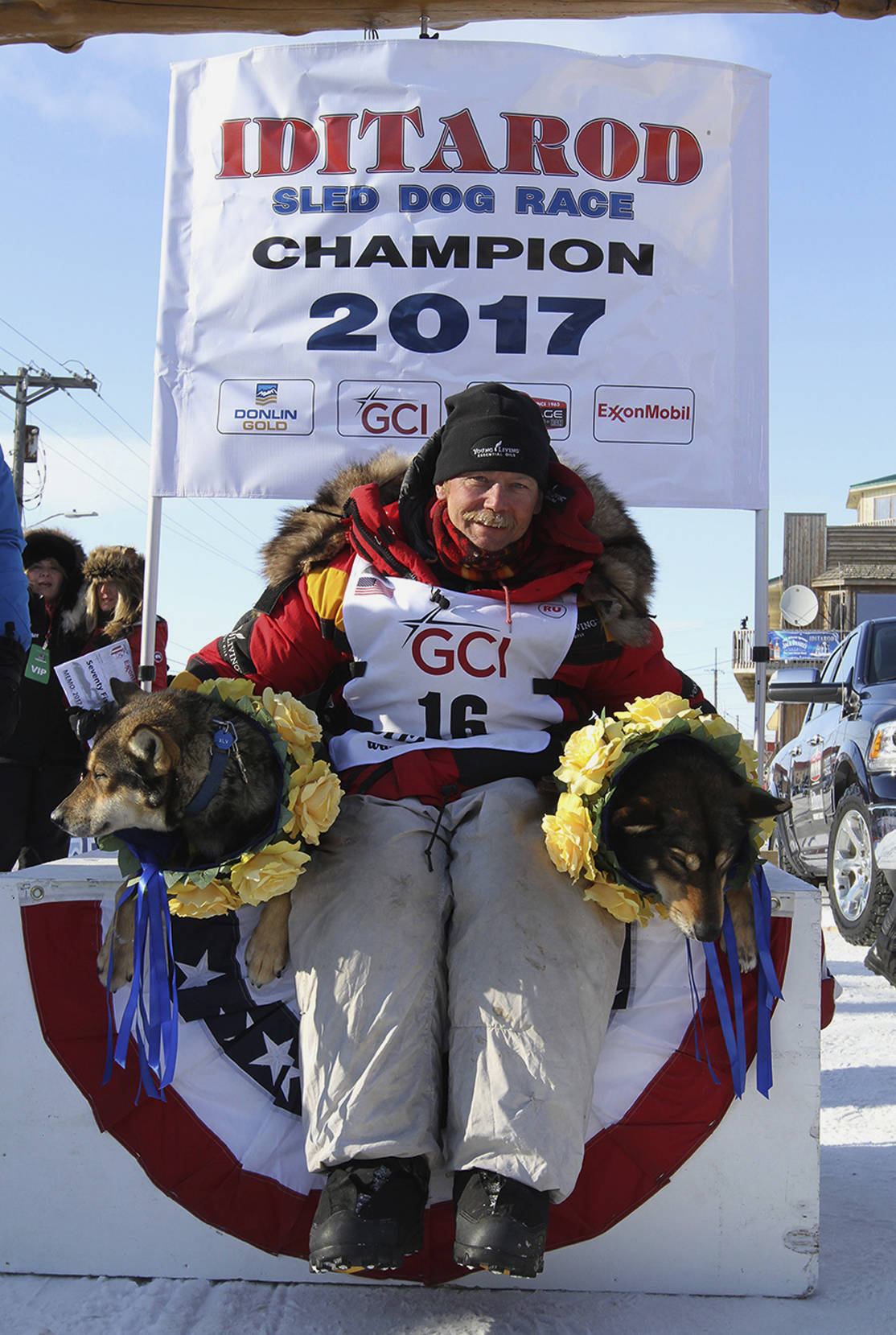
Iditarod champion Mitch Seavey of Sterling, Alaska, poses with his lead dogs Pilot, left, and Crisp under the Burled Arch after winning the 1,000-mile Iditarod Trail Sled Dog Race, in Nome, Alaska, Tuesday, March 14, 2017. Seavey won his third Iditarod Trail Sled Dog Race on Tuesday, becoming the fastest and oldest champion at age 57 and helping cement his family’s position as mushing royalty. (AP Photo/Diana Haecker)
Iditarod champion Mitch Seavey of Sterling, Alaska, poses with his lead dogs Pilot, left, and Crisp under the Burled Arch after winning the 1,000-mile Iditarod Trail Sled Dog Race, in Nome, Alaska, Tuesday, March 14, 2017. Seavey won his third Iditarod Trail Sled Dog Race on Tuesday, becoming the fastest and oldest champion at age 57 and helping cement his family’s position as mushing royalty. (AP Photo/Diana Haecker)
Mitch Seavey, of Sterling, Alaska, runs towards the finish line under the Burled Arch, winning the 1,000-mile Iditarod Trail Sled Dog Race, in Nome, Alaska, Tuesday, March 14, 2017. Seavey won his third Iditarod Trail Sled Dog Race on Tuesday, becoming the fastest and oldest champion at age 57 and helping cement his family’s position as mushing royalty. (AP Photo/Diana Haecker)

Mitch Seavey, of Sterling, Alaska, runs towards the finish line under the Burled Arch, winning the 1,000-mile Iditarod Trail Sled Dog Race, in Nome, Alaska, Tuesday, March 14, 2017. Seavey won his third Iditarod Trail Sled Dog Race on Tuesday, becoming the fastest and oldest champion at age 57 and helping cement his family’s position as mushing royalty. (AP Photo/Diana Haecker)

Iditarod champion Mitch Seavey of Sterling, Alaska, poses with his lead dogs Pilot, left, and Crisp under the Burled Arch after winning the 1,000-mile Iditarod Trail Sled Dog Race, in Nome, Alaska, Tuesday, March 14, 2017. Seavey won his third Iditarod Trail Sled Dog Race on Tuesday, becoming the fastest and oldest champion at age 57 and helping cement his family’s position as mushing royalty. (AP Photo/Diana Haecker)

Iditarod champion Mitch Seavey of Sterling, Alaska, poses with his lead dogs Pilot, left, and Crisp under the Burled Arch after winning the 1,000-mile Iditarod Trail Sled Dog Race, in Nome, Alaska, Tuesday, March 14, 2017. Seavey won his third Iditarod Trail Sled Dog Race on Tuesday, becoming the fastest and oldest champion at age 57 and helping cement his family’s position as mushing royalty. (AP Photo/Diana Haecker)

More in News

A snowmachine rider takes advantage of 2 feet of fresh snow on a field down Murwood Avenue in Soldotna, Alaska, on Monday, Dec. 12, 2022. (Jake Dye/Peninsula Clarion)
Ice fishing opens on some Kenai National Wildlife Refuge lakes

Snowmachines are permitted for ice fishing access on Hidden, Kelly, Petersen, Engineer and Watson lakes.

The waters of Cook Inlet lap against Nikishka Beach in Nikiski, Alaska, where several local fish sites are located, on Friday, March 24, 2023. (Jake Dye/Peninsula Clarion)
Kenai asks for fishery economic disaster declaration

The Kenai City Council requested that Gov. Dunleavy declare a disaster and support a recovery plan for the Upper Cook Inlet East Side Set Net fishery.

The Kenai Peninsula Borough School District logo. (Photo courtesy of Kenai Peninsula Borough School District)
District superintendent dispels rumors about student construction

Superintendent Clayton Holland said student involvement in Seward High School construction is “based on rumor, not fact.”

Anchorage-based singer and songwriter Keeley Boyle is pictured in Anchorage<ins>, Alaska,</ins> on Sept. 26, 2023. Boyle, who was raised on the Kenai Peninsula, will use a $10,000 grant she received from the Rasmuson Foundation to create an album of songs about her grandparents’ home in Nikiski. Photo courtesy of Jovell Rennie
Musician hailing from Kenai receives Rasmuson grant

Keeley Boyle will record an album of songs about her grandparents’ Nikiski home.

Commercial fishing and recreational vessels are docked in the Homer harbor on Oct. 23, 2025. The commercial fishing industry endured a series of challenges over the year, some of them imposed by the new Trump administration. (Photo by Yereth Rosen/Alaska Beacon)
Alaska fisheries in 2025: turmoil, economic and environmental challenges and some bright spots

NOAA cuts, economic headwinds and invasive species pose problems, but there was some recovery in crab stocks and salmon harvests.

Cook Inlet near Clam Gulch is seen on Oct. 23, 2025. (Photo by Yereth Rosen/Alaska Beacon)
Disputed oil lease sale in Alaska’s Cook Inlet upheld in new Trump administration decision

After completing a court-ordered environmental study, the Bureau of Ocean Energy Management said no changes are needed for the 2022 sale that drew just one bid.

The Kenai Peninsula Borough School District logo.
School district projects $7.5 million budget deficit for fiscal year 2027

Decreased enrollment and increased property values mean less local and state funding.

The sign in front of the Homer Electric Association building in Kenai, Alaska as seen on April 1, 2020. (Photo by Brian Mazurek/Peninsula Clarion)
Homer Electric Association announces rate increase

The proposed increase, if approved by the Regulatory Commission of Alaska, will go into effect Jan. 1.

A photo of Anesha “Duffy” Murnane, missing since Oct. 17, 2019, in Homer, Alaska. (Photo provided, Homer Police Department)
Calderwood pretrial hearing rescheduled

The omnibus hearing for Kirby Calderwood was continued to Jan. 21. Trial week is currently scheduled for Feb. 17, barring finalization of a plea agreement.

Most Read