
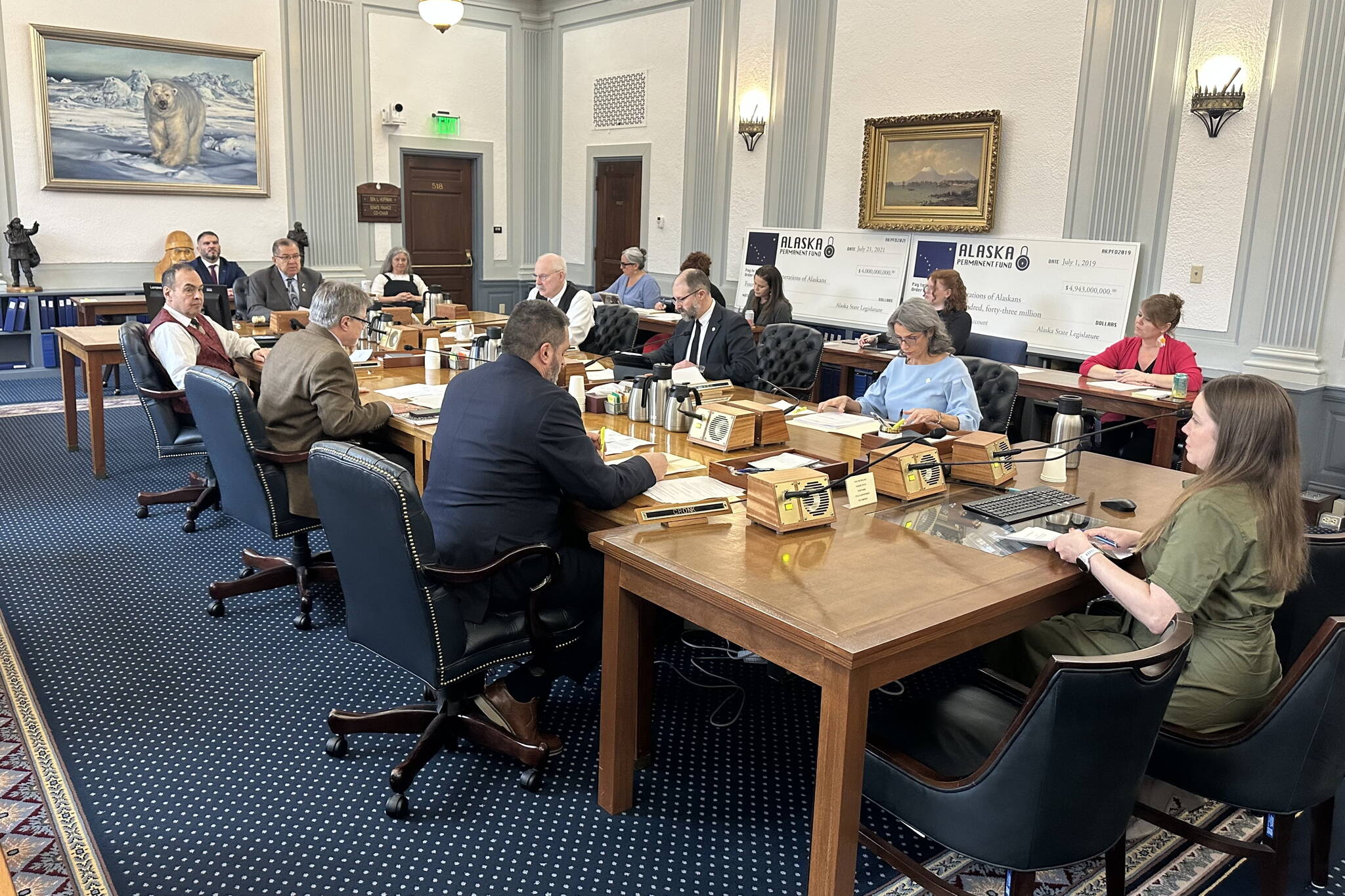
An education bill with newly added policy provisions as well as a $700 increase in per-student funding was quickly advanced out of the Senate Finance Committee on Thursday, clearing the way for a floor vote as state lawmakers try to work out a compromise agreement with four weeks left in the legislative session.
House Bill 57, which originally proposed limits on student cellphone use, was modified on Wednesday to include a $700 increase in the statutory $5,960 base student allocation after the Legislature on Tuesday failed to override Gov. Mike Dunleavy’s veto of a bill with a $1,000 increase. The bill is tentative scheduled for floor debate Friday.
On Thursday, HB 57 was further modified with provisions related to monitoring academic progress of students, easing regulations for charter schools and establishing a legislative task force on education funding. Those address some of the general policy goals Dunleavy and fellow Republican legislators have said they are seeking as part of an education package, but fall short of specific proposals such as allowing the state to bypass school districts and directly authorize new charter schools.
The policies included in the revised HB 57 are based on discussions in recent days with legislators in the majority and minority caucuses, as well as the governor’s office, said Sen. Bert Stedman (R-Sitka), co-chair of the Senate Finance Committee, in an interview after Thursday’s meeting.
“We’re just going around and around and nobody’s agreeing,” he said. “So we’ve tried to get some stuff that some people could agree on and move along because we got to get to dealing with the budget.”
Tuesday’s veto override failed by a 33-27 vote, seven short of the necessary two-thirds total. Sen. Jesse Kiehl (D-Juneau) said one objective of the amended HB 57 with the lower BSA increase is hoping enough additional votes will be found if another override vote takes place before the end of the session.
However, skepticism about the new version was voiced during the committee meeting by Sen. James Kauffman (R-Anchorage), who noted Dunleavy has the leverage of a line-item veto in the budget that he can use if the Legislature tries to force an education bill through he disapproves of.
“I want to just remind everybody, particularly folks listening at home, that this job’s not done until we get past that last hurdle, which is avoiding a three-quarter line-item veto in the budget because that’s an insurmountable task to try and override,” Kauffman said. “So I hope that folks are aiming at a durable solution with what we’re doing with this — and if we’re not we’re not really winning anything.”
Dunleavy vetoed the $1,000 BSA increase in HB 69 last Thursday, stating the bill had been stripped of all policy provisions that existed in previous versions and criticizing its roughly $250 million price tag. He previewed a new bill formally introduced this week (HB 204) that contains a $560 BSA increase, about $140 per-student in funds dedicated for specific purposes and several policy provisions he has included in other legislation this session.
The governor, in a social media message Thursday, said he is willing to support the revised HB 57 if some of his goals are added to it.
“If legislators make a few key edits, including restoring the reading grants, adding open enrollment, ensuring full funding for correspondence students, and including the four charter school reforms, I will sign this bill,” he wrote. “I look forward to working with lawmakers to make HB 57 a bill that strengthens outcomes, expands opportunity, and responsibly increases education funding.”
The revised HB57 — which in addition to a $700 BSA hike contains a 10% increase for student transportation — has an estimated price tag of $184 million, roughly equal to what the governor’s bill would cost. Both would essentially provide funding similar to a one-time $680 BSA increase for the current year, although Dunleavy’s bill would give school districts a smaller amount of funding they have control over in determining their budgets.
The Juneau Board of Education has approved a budget for the fiscal year that starts July 1 that assumes a $400 BSA increase.
Education funding, typically a major issue during the legislative session, has been particularly contentious this year due to vetoes by Dunleavy of increases the past two years as well as an increasingly shaky economic outlook for the state. A drop in oil prices, plus other concerns such as the impacts of Trump administration policies such as global tariffs and a possible recession, means the state at a minimum is expected to have hundreds of millions of dollars less in revenue than officials expected when the session began in January.
At the same time, boosting education funding has received bipartisan support — but with sharp differences on how much and with what strings attached. HB 69 originally contained a $1,269 BSA increase next year and $2,550 over three years when it was introduced by Rep. Rebecca Himschoot (I-Sitka), which she said was the amount necessary to make up for the erosive effects of inflation due to relatively flat BSA funding since 2011.
However, other lawmakers said a large BSA increase would likely come at the cost of a smaller Permanent Fund dividend, due to reluctance to tap too far into the $2.8 billion Constitutional Budget Reserve to cover any shortfall in next year’s budget. The budget passed by the House with the $1,000 BSA hike also contains an estimated PFD of about $1,400 and an effective deficit of about $530 million (including a roughly $450 million stated deficit and $80 million “unallocated cut” Dunleavy is supposed to make, which legislative attorneys have stated likely is not legal).
Stedman said Thursday the Senate Finance Committee has trimmed about $200 million from the House’s budget and the plan is to make further cuts so the spending plan doesn’t tap into reserve funds.
• Contact Mark Sabbatini at mark.sabbatini@juneauempire.com or (907) 957-2306.
