
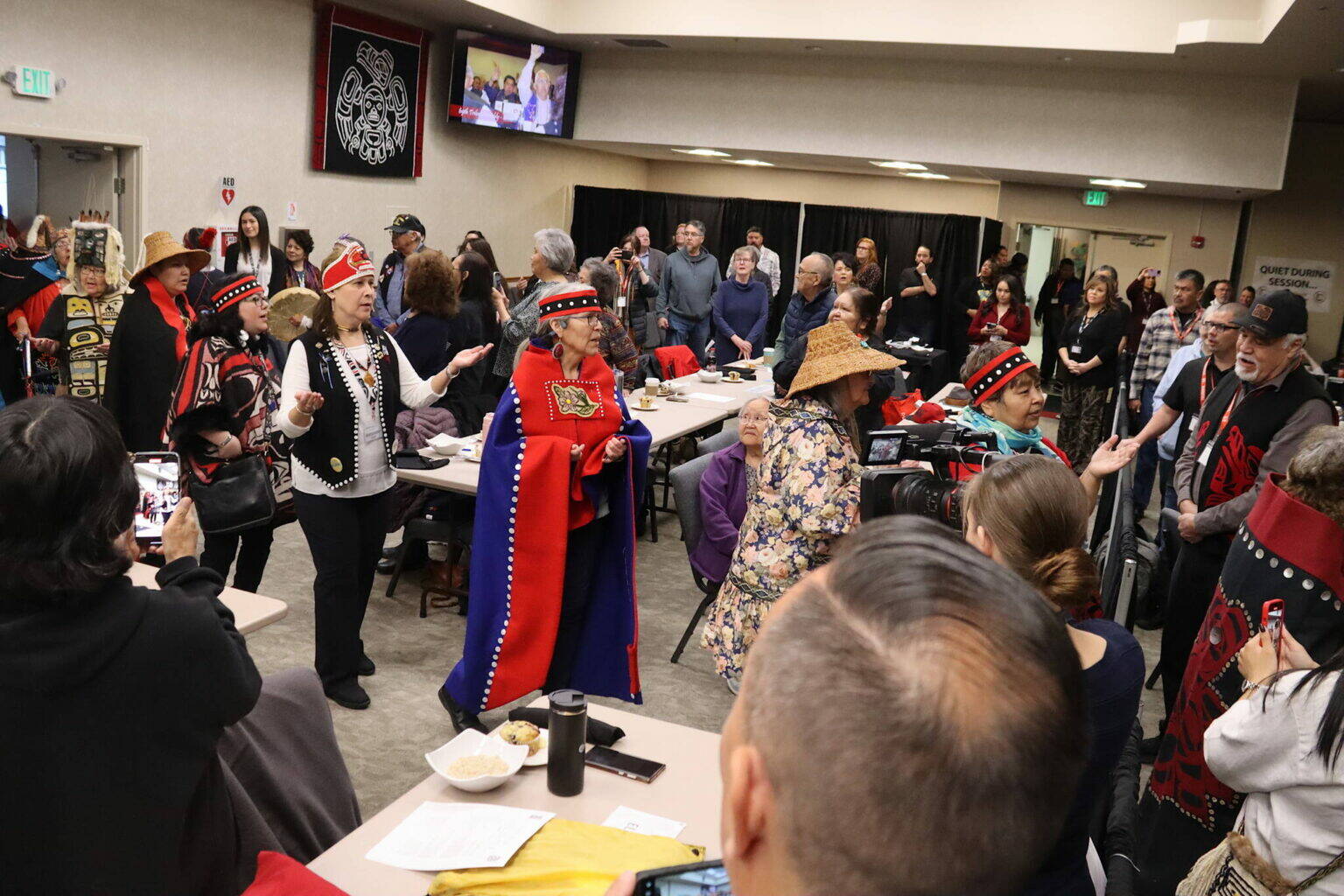
The Tlingit and Haida Elders Group performs the entrance dance at the 89th annual Tribal Assembly of the Central Council of the Tlingit and Haida Indian Tribes of Alaska on Wednesday, April 17, 2024, at Elizabeth Peratrovich Hall. (Mark Sabbatini / Juneau Empire file photo)

The Tlingit and Haida Elders Group performs the entrance dance at the 89th annual Tribal Assembly of the Central Council of the Tlingit and Haida Indian Tribes of Alaska on Wednesday, April 17, 2024, at Elizabeth Peratrovich Hall. (Mark Sabbatini / Juneau Empire file photo)

Trump rescinds Biden executive order expanding tribal sovereignty and self-governance

Order giving Natives more access to federal funds cited in awarding of major Southeast Alaska projects.

A 2023 executive order expanding sovereignty rights for the nation’s 574 federally recognized tribes was revoked Friday by President Donald Trump, putting major tribal projects and policies in Juneau and elsewhere in question.

Executive Order 14112, signed by President Joe Biden during the White House Tribal Nations Summit in early December of 2023, sought to give Native Americans more access to federal funding and spending autonomy.

The order was referenced by the Federal Emergency Management Agency in recognizing expanded tribal involvement in emergency responses and the Environmental Protection Agency in awarding a $15 million grant for five Southeast Alaska composting facilities, as well as other tribal projects ranging from fisheries management to broadband connectivity.

Impacts of Trump’s revocation were not immediately clear to tribal leaders.

“We are actively monitoring developments related to this order and will continue to assess its impact,” Dixie Hutchinson, a spokesperson for The Central Council of the Tlingit and Haida Indian Tribes of Alaska, wrote in an email to the Empire on Saturday morning.

Bryan Newland, Assistant Secretary for the Assistant Secretary of the Department of the Interior for Indian Affairs from 2021 to 2025, told Native News Online on Saturday that “rolling back this executive order increases federal interference with local actions.”

“This executive order was intended to reduce government interference with how tribes spend their money, and to ensure that federal agencies are actually meeting their legal obligations for tribes,” he said. “It made the government more efficient for Indian people.”

Trump’s revocation on Friday was among 18 Biden-era orders nixed in an announcement made late in the day, adding to an ongoing massive redefining of the federal government that includes the 78 presidential orders rescinded when Trump took office on Jan. 20.

Among the other Biden-era orders revoked Friday involved “ensuring a data-driven response” to COVID-19 and subsequent public health threats, raising the minimum wage for federal contractors, allocating federal resources for renewable energy projects, and advocating for LGBTQ+ human rights globally.

“I have determined that the following additional rescissions are necessary to advance the policy of the United States to restore common sense to the Federal Government and unleash the potential of American citizens,” Trump wrote in the presidential action titled “Additional rescissions of harmful executive orders and actions.”

Trump also on Friday signed an executive order to eliminate several agencies including the parent agency of Voice of America, with much of its worldwide news coverage coming to a halt as of Saturday.

Biden’s signing of Executive Order 14112 was hailed as a highlight of the 2023 tribal summit. Among its provisions was creating a “one-stop-shop” federal funding hub for Native American businesses called the Tribal Access to Capital Clearinghouse. A search for “Alaska” at the site on Saturday afternoon returned 696 “funding opportunities” in a nationwide database of 1,218 items.

“Tribal Nations still face many barriers to fully exercise their inherent sovereignty, especially in federal funding programs,” Biden’s executive order stated. “Far too many of the federal funding and support programs that Tribes rely on are difficult to access, have overly burdensome federal reporting requirements, have unnecessary limitations, or impose requirements on Tribes that drain Tribal resources and undermine their ability to make their own decisions about where and how to meet the needs of their communities.”

• Contact Mark Sabbatini at mark.sabbatini@juneauempire.com or (907) 957-2306.

More in News

A snowmachine rider takes advantage of 2 feet of fresh snow on a field down Murwood Avenue in Soldotna, Alaska, on Monday, Dec. 12, 2022. (Jake Dye/Peninsula Clarion)
Ice fishing opens on some Kenai National Wildlife Refuge lakes

Snowmachines are permitted for ice fishing access on Hidden, Kelly, Petersen, Engineer and Watson lakes.

The waters of Cook Inlet lap against Nikishka Beach in Nikiski, Alaska, where several local fish sites are located, on Friday, March 24, 2023. (Jake Dye/Peninsula Clarion)
Kenai asks for fishery economic disaster declaration

The Kenai City Council requested that Gov. Dunleavy declare a disaster and support a recovery plan for the Upper Cook Inlet East Side Set Net fishery.

The Kenai Peninsula Borough School District logo. (Photo courtesy of Kenai Peninsula Borough School District)
District superintendent dispels rumors about student construction

Superintendent Clayton Holland said student involvement in Seward High School construction is “based on rumor, not fact.”

Anchorage-based singer and songwriter Keeley Boyle is pictured in Anchorage<ins>, Alaska,</ins> on Sept. 26, 2023. Boyle, who was raised on the Kenai Peninsula, will use a $10,000 grant she received from the Rasmuson Foundation to create an album of songs about her grandparents’ home in Nikiski. Photo courtesy of Jovell Rennie
Musician hailing from Kenai receives Rasmuson grant

Keeley Boyle will record an album of songs about her grandparents’ Nikiski home.

Commercial fishing and recreational vessels are docked in the Homer harbor on Oct. 23, 2025. The commercial fishing industry endured a series of challenges over the year, some of them imposed by the new Trump administration. (Photo by Yereth Rosen/Alaska Beacon)
Alaska fisheries in 2025: turmoil, economic and environmental challenges and some bright spots

NOAA cuts, economic headwinds and invasive species pose problems, but there was some recovery in crab stocks and salmon harvests.

Cook Inlet near Clam Gulch is seen on Oct. 23, 2025. (Photo by Yereth Rosen/Alaska Beacon)
Disputed oil lease sale in Alaska’s Cook Inlet upheld in new Trump administration decision

After completing a court-ordered environmental study, the Bureau of Ocean Energy Management said no changes are needed for the 2022 sale that drew just one bid.

The Kenai Peninsula Borough School District logo.
School district projects $7.5 million budget deficit for fiscal year 2027

Decreased enrollment and increased property values mean less local and state funding.

The sign in front of the Homer Electric Association building in Kenai, Alaska as seen on April 1, 2020. (Photo by Brian Mazurek/Peninsula Clarion)
Homer Electric Association announces rate increase

The proposed increase, if approved by the Regulatory Commission of Alaska, will go into effect Jan. 1.

A photo of Anesha “Duffy” Murnane, missing since Oct. 17, 2019, in Homer, Alaska. (Photo provided, Homer Police Department)
Calderwood pretrial hearing rescheduled

The omnibus hearing for Kirby Calderwood was continued to Jan. 21. Trial week is currently scheduled for Feb. 17, barring finalization of a plea agreement.

Most Read